























IT Outsourcing
Need an extra developer, a UX/UI designer or a whole development team? In the staff augmentation model (IT body leasing), we join your team and work within its processes. As a dedicated team, we can also take over organizing the work and delivering the project. We work with React, Next.js, Node.js and Python. You can scale the team up or down as the project's needs change.
Companies that trusted us
The basics
When to hire a team, and when to hire full-time
IT outsourcing means bringing people from outside your company in to work on your product. It comes in two forms that are easy to confuse when ordering. Team augmentation means filling out your existing team with individual people who work under your management, within your processes. A dedicated team is a group that also takes on running the work and is accountable for results, not just for being there. Outsourcing has the edge when the need is temporary, the skill is rare or the deadline can't wait for recruitment. Full-time hiring wins when the skill is at the core of your product and needs to stay in the company for years — knowledge of the system built up by an outside person leaves with them, unless you make sure it's handed over.
IT outsourcing works best when you need extra skills quickly, are growing the team for the duration of a project or don't want to start a long recruitment process. In the staff augmentation model, an external developer or designer joins your team and works under its direction. A dedicated team, on the other hand, can take over a larger share of responsibility for organizing and delivering the work. Full-time hiring is the better option if a given skill is key to the company and you know you'll need it for many years. Outsourcing doesn't replace a good process, though. Clear priorities, accountability, code review and testing are still needed — whether the work is done by an internal or an external team.
See the IT outsourcing projects we delivered for clients
„Completion of the mockups, successful development and launch of the e-commerce website. We were impressed with their knowledge and commitment. At every phase of the project, their team was ready to answer all our questions and provide valuable suggestions.”
Tomasz Szpin — Director, GlobalParts-UK Limited
Review from Clutch
How we work
How we start working together and who's responsible for what
We start with a conversation about the scope and what form of support you really need — because sometimes the request is "two developers", but the real problem is that nobody is leading the work. Then we select people, introduce them, and you decide. Onboarding starts with access to the repository and documentation.
With body leasing, on your side remain prioritization, reviews and product decisions. With a dedicated team, the direction and acceptance of results stay with you, while organizing the work moves to us. On our side, there's always code quality, cover during absences and continuity of knowledge.
The start date depends mainly on two things: the availability of the specific skill and the formalities on your side — the contract, NDA and access.
Decisions
Decisions that determine whether an outsourced team actually speeds things up
Body leasing or a dedicated team. The first gives you control and requires your time to manage it. The second takes management off your plate and requires trust in someone else's decisions. The choice comes down to one question: how many hours a week can you realistically give this project? It's worth answering honestly before you start, not after a month.
Who looks after quality. If nobody on your side reviews the code, you need that covered in the contract on the vendor's side. Not agreeing on this is the most common reason why, a year later, nobody wants to touch what the collaboration produced.
What the exit looks like. Agree at the start what happens at the end: where the documentation is, who has access and how long the handover takes. A collaboration you can't leave without a crisis costs more than the invoice suggests.
What not to do. Don't pay only for hours worked without an agreed outcome — that rewards presence, not results. Don't add people to a delayed project in the hope that it will speed up; first check what's actually blocking it.
Scope
What exactly you're hiring
Outsourcing with us comes in two modes: a dedicated team that runs the project from start to finish, or staff augmentation — our people in your team and your processes. We provide React, Next.js, Node.js and Python developers as well as UX/UI designers, and the team scales up and down with the rhythm of the project.
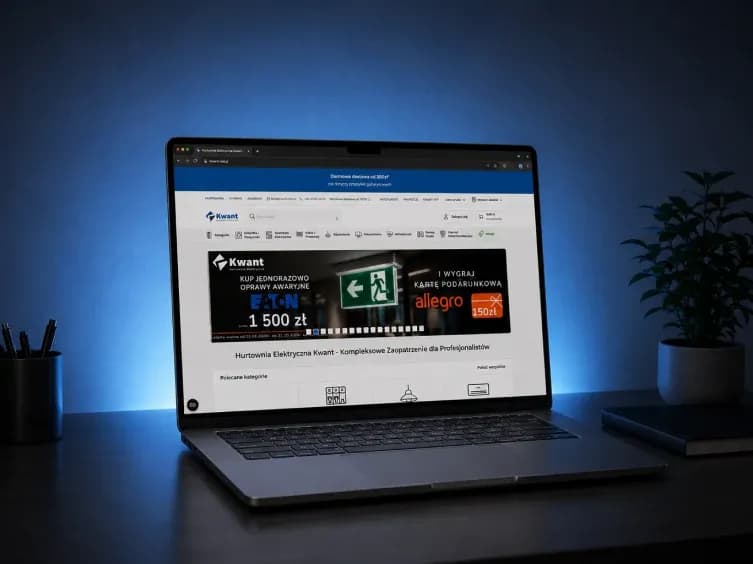
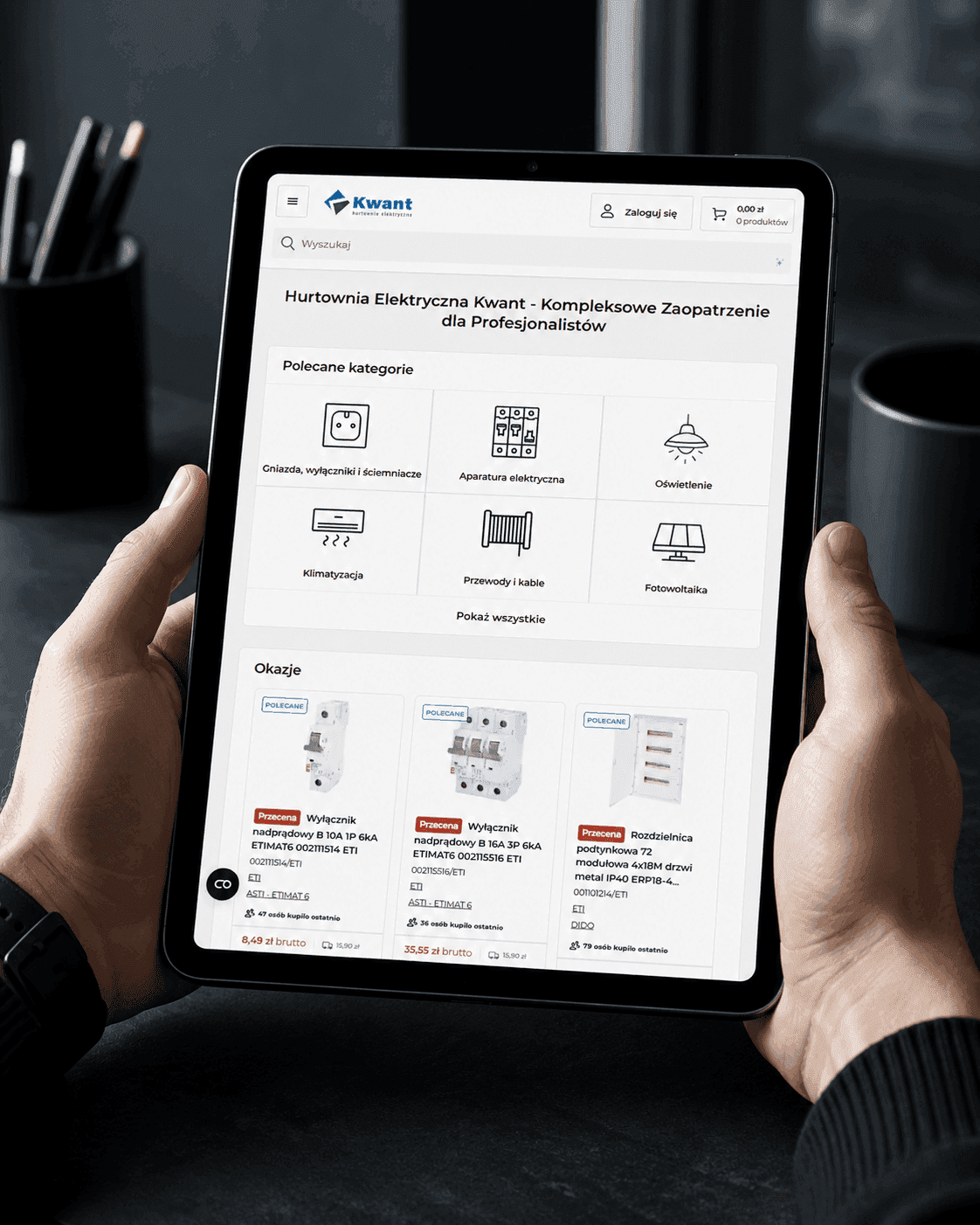
This is the model behind, among others, the e-commerce platform for Kwant, a nationwide chain of electrical wholesalers — tens of thousands of products in one interface, run by our team in collaboration with the client's team.
We match the billing model to the nature of the collaboration: a fixed team on a monthly retainer, billing for time worked or a fixed price for an agreed scope — with transparent reporting of hours and progress in every option.
You're hiring skills, not headcount: front-end and back-end developers, full-stack developers, UX/UI designers and, if needed, someone to lead the project. The team isn't fixed: we add people for peak workloads, and after launch the team scales down to a maintenance setup.
We match the billing model to the nature of the collaboration: a fixed team on a monthly retainer, a rate for time actually worked or a fixed price for an agreed scope. In every option, you get a transparent report of hours and progress.
The dedicated team model is behind, among others, the e-commerce platform for Kwant, a nationwide chain of electrical wholesalers — tens of thousands of products in one interface, run by our team together with the client's team.
Technologies we work with
- Team skills
Our specialists work with the React / Next.js / Node.js stack with TypeScript, and our designers in Figma — they join the project with no time needed to learn the tools.
Collaboration
You're hiring a team that also builds its own products
The difference between us and a catalog of CVs is simple: our people develop products every day — our own website with thousands of pages, client applications developed over years. They join your team with product habits, not a list of technologies. They treat code review, CI/CD and testing as a given, because that's how they work in-house.
You talk directly to the developer or designer — without a layer of account managers translating what the team meant.
Start and scale
Your first developer in weeks, not quarters
Getting started is quick: a conversation about your needs, matching the right people, a technical interview with your side — and then work. No months-long recruitment and no risk of a bad full-time hire. If the fit isn't right, we replace the person instead of explaining that the contract is binding.
Knowledge doesn't evaporate along the way: documentation and knowledge transfer are part of the collaboration, not a paid add-on at the end.
Electrical Engineering / SmartTech
We work with distributors and manufacturers of electrical components and SmartTech devices.
Electrical Engineering / SmartTech ↗
PRODUCTS
Tell us what you want to build — we'll take care of the rest

We design and build online stores. We connect sales with ERP, WMS, payments and logistics so the store runs smoothly even with a large product catalog, multiple markets and a growing number of orders.
FAQ
Questions we hear before we start working together
- IT outsourcing means entrusting part of the technical work to a team outside your company — from a single developer joining your team to a standalone team running an entire project. Unlike hiring, you don't take on the burden of recruitment, staff turnover or maintaining competencies you only need periodically.
- With body leasing (also known as team augmentation), our specialists work within your processes and under your direction — priorities and reviews stay on your side. With a dedicated team, we also take on organising the work and are responsible for results, not just availability. The first model requires your time; the second requires trust in our decisions.
- Billing is typically based on an hourly rate or a monthly cost per person, not a project quote — because the scope is on your side and can change. The rate depends on experience and role; the total cost depends on whether you need individual contributors or a team with its own management. It's worth comparing not just the rates but the total cost including recruitment, onboarding and the turnover risk that you absorb with a full-time hire.
- With a standard web stack, finding the right people is fast. For narrow specializations, expect some lead time. In practice, the start is most often delayed by paperwork and access setup on the client's side, not by availability on ours.
- Intellectual property rights to the code produced transfer to you — we write this into the contract. Confidentiality is covered by an NDA signed before any access to materials, and our people work in your repositories and your environments according to your access policies.
- We agree on handover scope at the start, not at the end: up-to-date documentation, access transfer and an overlap period during which your team can ask questions. We want leaving the collaboration to be a business decision, not a rescue operation.

Let's build digital products for your company together
Other services

Web Development
We design and build custom web applications - from an MVP that lets you quickly validate an idea to large platforms and systems developed over years. We build both the front end and the backend, APIs, databases, admin panels and integrations with external systems. We work with Next.js, React, Node.js, NestJS, Python, PostgreSQL and MongoDB, among others. We create solutions tailored to a specific business process: SaaS applications, internal systems, sales platforms, websites, marketplaces and CMS systems.
Learn moreUX/UI Design
We design UX/UI for web and mobile applications and B2B systems - from analyzing user needs and early wireframes to the finished interface and a design system in Figma. We don't design screens in isolation from the product. We look at user journeys, analytics data and technical constraints to create a solution that's easy to use and can be built efficiently. After the product launches, we can come back to heatmaps, session recordings, analytics and user interviews, so that the next changes are driven by data, not assumptions.
Learn moreE-commerce
We design and build online stores and e-commerce platforms tailored to your sales model and business processes. We work with off-the-shelf solutions as well as headless architecture and custom sales systems. We build e-commerce for B2C and B2B sales, large product catalogs, multiple markets and marketplaces. We integrate stores with ERP, WMS, CRM, PIM, payments and logistics, and design product configurators and custom purchase flows. We also take care of performance, technical SEO and preparing the platform for seasonal traffic peaks.
Learn more