

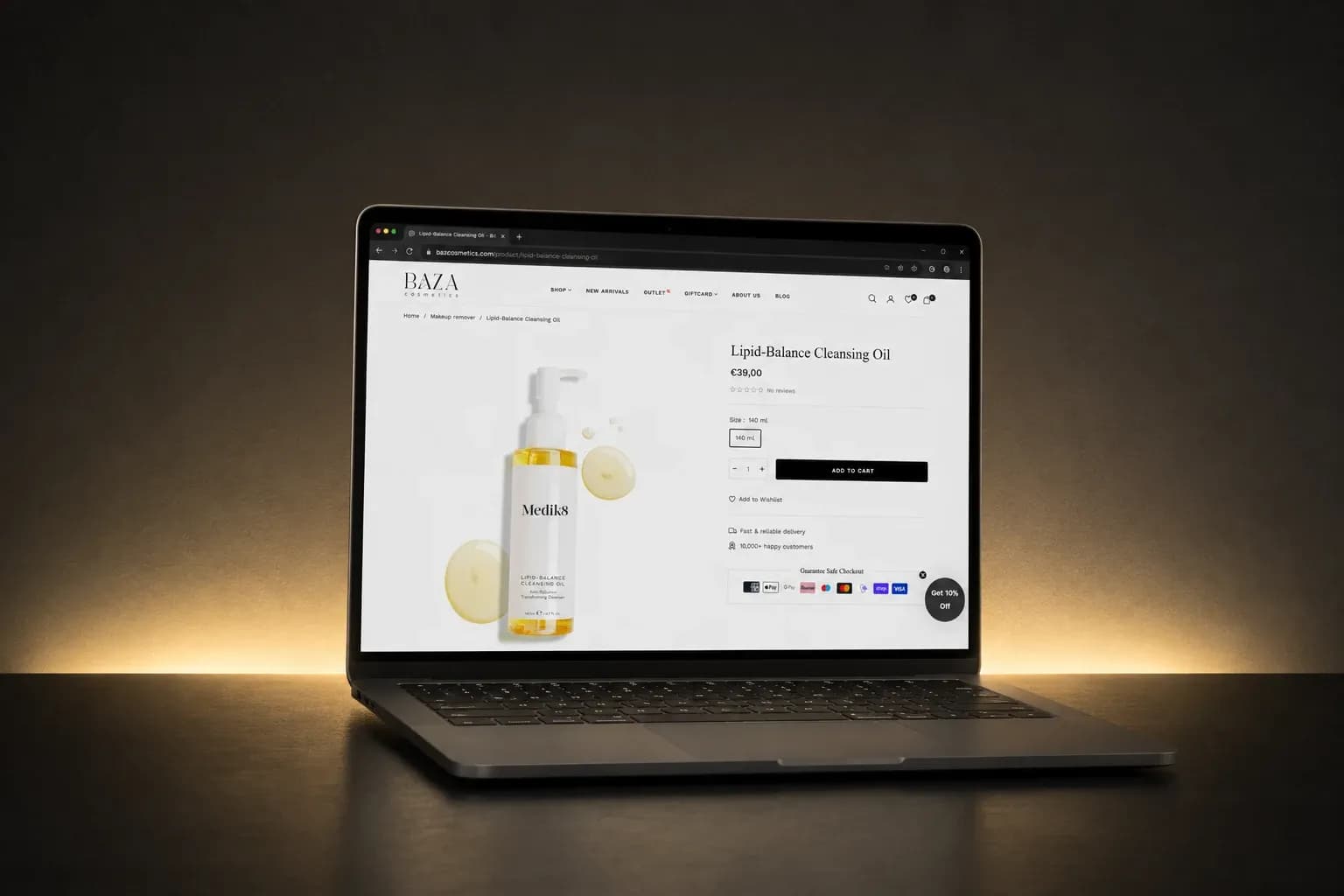
A premium cosmetics marketplace in 9 European markets – Shopify Plus
Client: Baza Cosmetics
Industry: Beauty & Cosmetics / BeautyTech
We work with cosmetics brands, manufacturers and beauty retailers that sell online. We build stores with detailed product pages, platforms that connect salons with clients, and catalogs ready for multi-market sales. We combine good UX, technology and integrations that make selling, customer service and business growth easier.
Our clients in beauty and cosmetics
When selling cosmetics online, it's not just about how the store looks. Customers want to find the right product quickly, learn about its ingredients, effects and available variants, and then get through checkout without any trouble. That's why we design beauty e-commerce around products and buying decisions — with clear product pages, filtering, search and integrations that keep data in order across the whole sales ecosystem.
At the heart of most projects is a store with a detailed product page: ingredients and intended use, size and shade variants, zoomable photos, customer reviews. Online stores like these are designed around search and the product page, not around a category catalog.
Another recurring topic is selling in several markets at once: language versions, currencies, different labeling requirements for ingredients, different couriers and payment methods. If the store architecture doesn't plan for this from the start, every new market means copying the store instead of adding configuration — and that doubles maintenance costs with every country.
The most common trap is a catalog maintained by hand in several places at once: the store, marketplaces, data feeds for partners. Stock levels and descriptions drift apart, and a customer orders a variant that isn't available. The fix is a single source of product data that every channel uses — for larger catalogs, that's a job for a PIM system.
For brands that combine their own sales with offers from salons and clinics, marketplace platforms are the natural next step — with separate seller accounts, commissions and settlements. That's a different project from a store: more roles, more settlements and content moderation that needs to be planned before the first partners join.
Client: Baza Cosmetics
Industry: Beauty & Cosmetics / BeautyTech
„The most important outcome of our collaboration was the brand's visual identity — distinctive and consistent with what we wanted to communicate. The website and store mockups we received were polished down to the last detail, and the pace of delivery was impressive.”
Krzysztof Kornas — CEO, High Culture sp. z o.o.
Review from Clutch
The basics
In this industry, two business models have completely different needs. A service salon lives by its calendar: bookings, reminders, treatment packages, each client's treatment history. A cosmetics brand lives by sales: the store, product variants, content, selling across several channels. In a salon, the biggest untapped potential isn't in taking bookings but in reducing no-shows and getting clients to come back. A text reminder the day before and a deposit for more expensive treatments do more than the best booking form — although for short treatments, a deposit can scare off more clients than it saves appointments. Treatment history lets you reach out when it actually makes sense, instead of sending one campaign to your entire list.
For a cosmetics brand, getting product data in order pays off faster than redesigning the store. For companies that do both, we advise against one system for everything.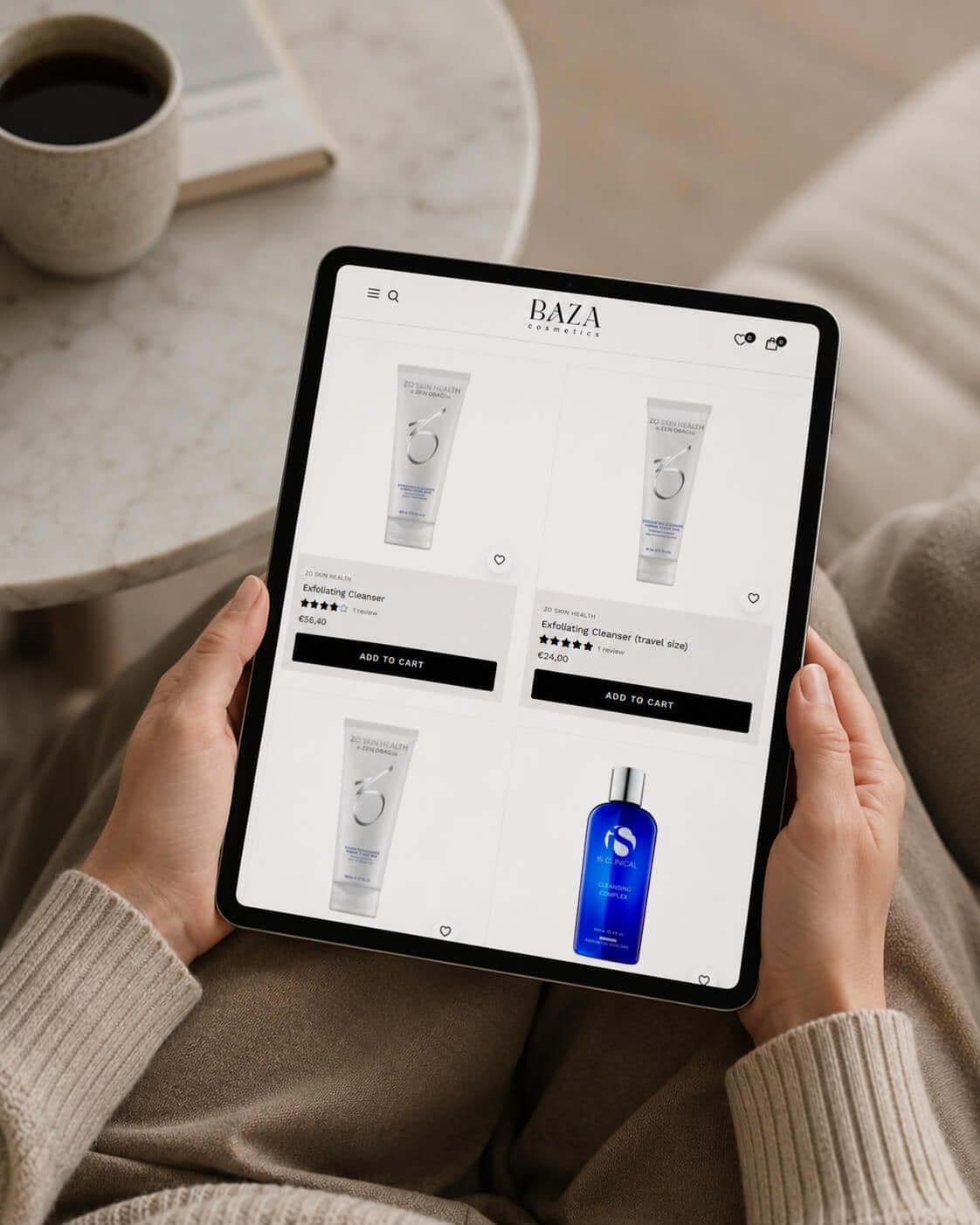
How we work
We start by understanding the process and the problem the technology is meant to solve. We look at where there's manual work, duplicated data, customer service issues or limitations of the current system. Then we agree on the key features and integrations. For a salon, that might be bookings, payments and a CRM; for a cosmetics brand — a product catalog, e-commerce, PIM, logistics or multichannel sales.
On your side are the price list and treatment durations, or the product data, the cancellation rules and someone who knows how a day in the salon really goes. On our side are implementation, integrations and end-to-end testing.
The timeline depends on the number of services and resources (stations, equipment, staff) or the number of product variants. One station and ten services takes days; a chain of salons with different price lists is a different project.
Decisions
A deposit when booking. It clearly reduces no-shows — and it clearly reduces the number of bookings too. For long, expensive treatments it usually pays off; for short ones it can scare off more clients than it saves appointments.
Reminders — when and through which channel. A text message the day before works best, and it costs money. It's worth comparing the cost of the message with the value of the appointment it saves — for short treatments, the math doesn't always add up.
Whether clients can cancel on their own. Self-service cancellation increases the number of cancellations but also frees up slots in advance. That's usually better than a no-show without warning, but it's a decision worth making deliberately.
What not to do. Don't keep the schedule in the system and in a paper notebook at the same time. Don't send the same campaign to everyone if you have treatment history. And don't launch online booking without working out how long it takes to prepare a station between clients.
Scope
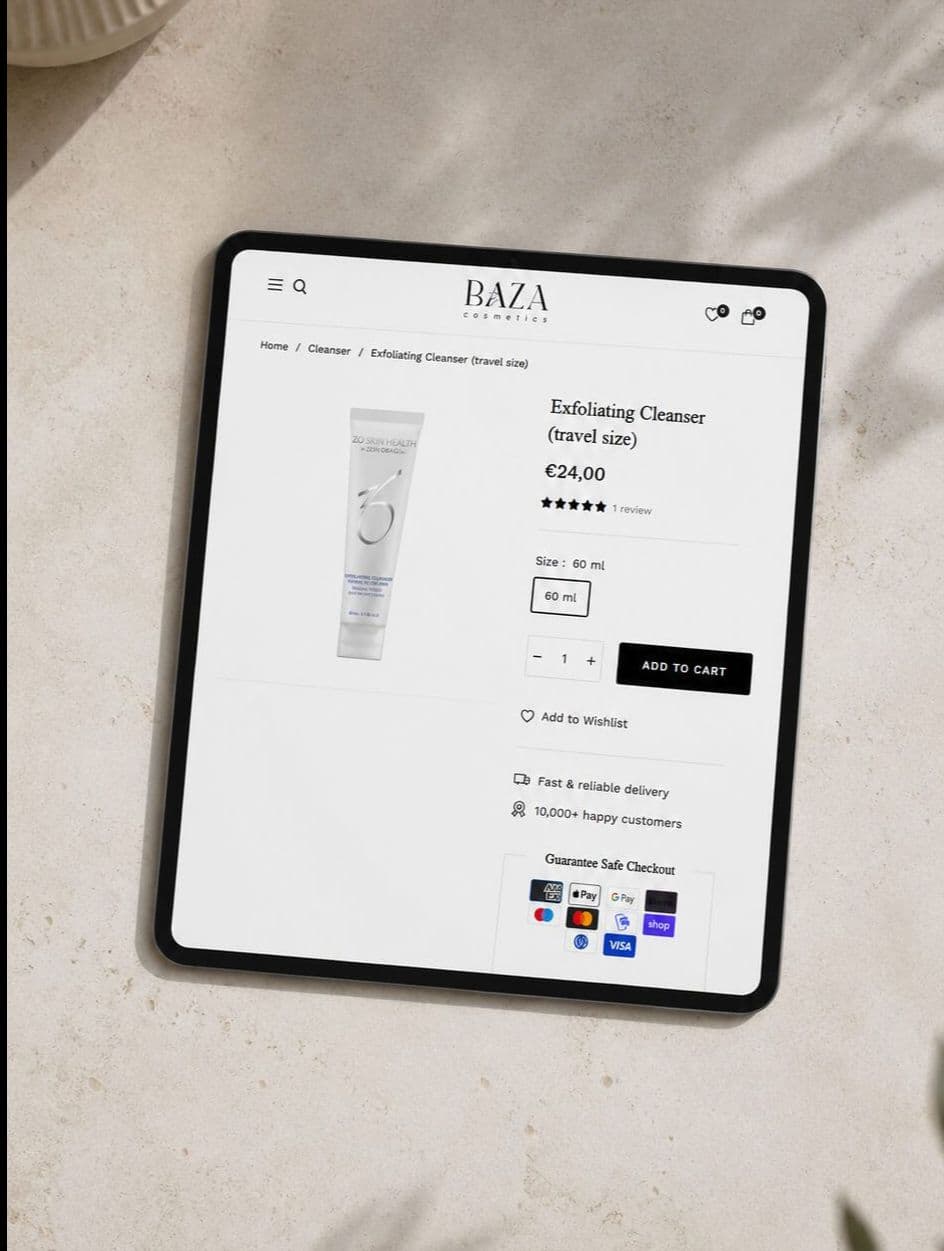
The Baza Cosmetics marketplace sells premium cosmetics from more than nine brands in nine European markets. Currencies, languages, prices and differences in how the offer is presented are handled in the Shopify Plus architecture rather than bolted on later: a shared catalog, localized content, and tax and shipping rules set per market — including a separate customs procedure for Switzerland. A tenth country then becomes a matter of configuration, not another project.
What we build
We build online stores and cosmetics marketplaces, booking systems, sales platforms and custom applications.
We also design features specific to the beauty industry: detailed product pages, filtering by ingredients and use, loyalty programs, subscriptions, customer accounts and integrations with PIM, CRM, payment and logistics systems.Multi-market
Growing international sales doesn't have to mean building a separate store for every country. We design platforms that use a shared product catalog while allowing content, prices, currencies, payments and shipping to be localized.
We took this approach with Baza Cosmetics, among others, where a single platform handles sales in nine European markets.FAQ

We design and develop digital solutions for financial services, insurance and lending companies and FinTech startups. We build online application forms, calculators, customer portals and custom systems, combining good UX with data security and a reliable architecture. We simplify processes that should feel simple to the user — even when complex rules, integrations and business requirements are running underneath.

For developers, real estate agencies, rental operators and PropTech companies, we build systems that bring order to sales, rentals and property data. We build custom CRMs, listing portals, booking systems, customer portals and analytics tools, among other things - integrated with the solutions your team already uses.

In construction and ConTech, we work with contractors, developers and design firms. We build construction project databases, job management systems and websites that bring order to B2B communication. Digitization arrives later here than elsewhere, so the starting point is often replacing paper and spreadsheets with one coherent system with a change history.

We build e-learning platforms and LMS systems for EdTech startups, universities, training companies and language schools. Here, success is measured by completed courses, not by the length of the feature list — so we start with the learner's journey: the first visit, visible progress and getting back to learning that was interrupted two weeks ago. Payments, group licenses and reports all serve that one goal.

We design websites and custom software for law firms, in-house legal departments and LegalTech companies. We build calculators, qualifying forms, document workflow systems and solutions that make case handling more efficient, among other things. We automate repetitive processes and leave legal judgment to the lawyer.

We work with parts manufacturers and distributors and automotive brands that sell online. We build stores and catalogs where customers get to the right part - by make, model and engine version, by OE number or by replacement. We make sure that expanding into new markets means configuring the existing platform, not building another store from scratch.