

Construction / ConTech
In construction and ConTech, we work with contractors, developers and design firms. We build construction project databases, job management systems and websites that bring order to B2B communication. Digitization arrives later here than elsewhere, so the starting point is often replacing paper and spreadsheets with one coherent system with a change history.
Our clients in construction


- Handyman ST


Digitization in construction starts with data, not with an app
In many construction companies, key information is still scattered across spreadsheets, emails, messaging apps and paper documents. We design systems that bring it together in one place and give everyone involved in a project easy access to up-to-date data.
Most often, we build construction project databases, job management systems and websites that bring order to B2B communication. What they have in common is large, scattered datasets that need to be presented in a clear way.
Why a spreadsheet stops being enough
As long as there are only a few projects, a spreadsheet does the job. Problems start when the site manager, the office and subcontractors all work on the same sheet: versions drift apart, attachments circulate by email and decisions are made on week-old data. The systems we build do one thing well: one database of projects, jobs and documents with role-based permissions — and a change history that shows who agreed what.
A common second stage is taking this data outward: a project showcase for investors, a partner area for subcontractors, preliminary quotes calculated from parameters. These projects sit somewhere between an internal tool and a sales website — and in this industry the website is often the main channel for winning new business partners, so we treat it as part of the system, not a business card. Content updated by the office runs on a headless CMS, so changes to the offer don't require a developer.
What's specific to this industry
The construction process involves many companies and people, so the system has to account for different roles, access levels and ways of working.
The company's sales website matters just as much. On large contracts, its job isn't only to present the offer but also to build credibility and generate inquiries. That's why we design websites for construction companies as part of the entire digital process — with a project portfolio, a CMS, SEO and room to grow.Case studies in construction
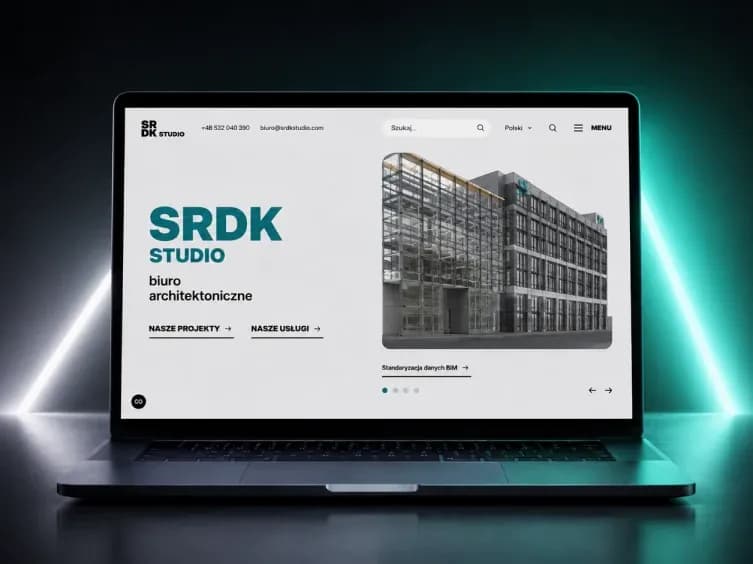
Migrating from WordPress to Strapi headless CMS – a 60% faster website
Client: SRDK Studio
Industry: Construction / ConTech
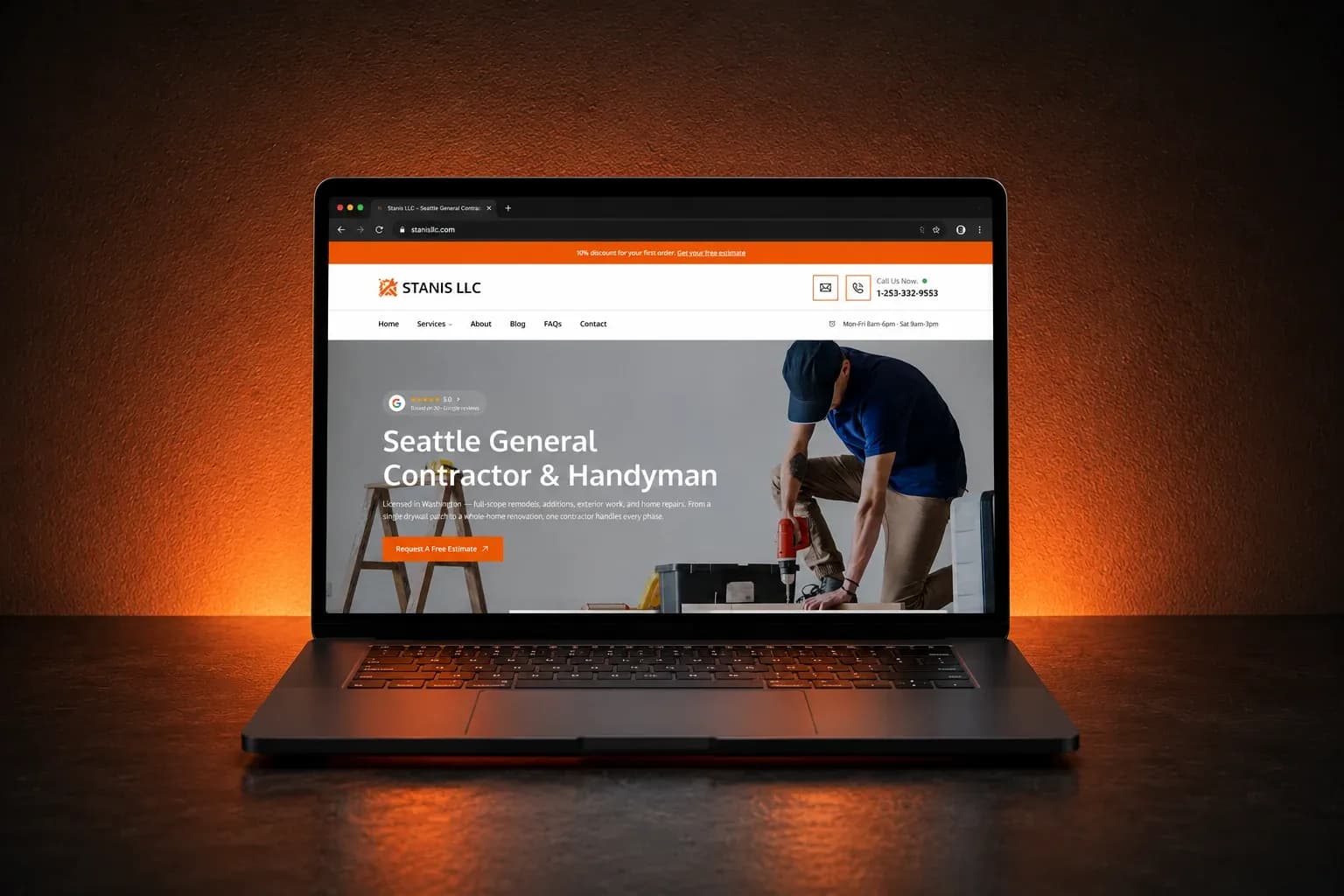
The CRM and local SEO that made Handyman ST stand out in Seattle
Client: Handyman ST
Industry: Construction / ConTech
„To us, Boring Owl is not just a software house but also a partner and advisor. The system's scope kept changing throughout the project, and every time we got a sensible recommendation, not just execution. After these years of working together, we have complete trust in the team's expertise.”
Hubert Zaborowski — Co-Owner, SHM Sp. z o.o.
Review from ClutchThe basics
Where time and information get lost in construction
ConTech is software for construction: document workflows, site diaries, cost estimates, subcontractor coordination, handovers and inspections. What's characteristic of this industry is that information moves between companies rather than within one — the investor, the general contractor, the designer and the subcontractors each work by their own rules. That's why the biggest losses don't come from the lack of a system but from inconsistency: two versions of a drawing in circulation, agreements from a site meeting in someone's notebook, a handover report sitting in an email. Each of these looks harmless on its own, and each can cause downtime.
That's why digitization is usually best started by sorting out documentation and data flow. Only on that foundation do the next pieces work well: issue workflows, handovers, progress reporting, schedules and integrations with BIM and other systems.

How we work
How we run construction projects
We start by getting to know the real process — together with the people who use it every day. We look at where information is retyped by hand, where delays occur and which tasks can be simplified. Then we design a single source of data, access rules and a way of working with documentation. Only on top of that do we build issue workflows, handover reports and progress reporting — things that only make sense when everyone is looking at the same documents.
On your side are the documentation, the list of everyone involved in the process and the decision about who approves. On our side are the system, integrations and the rollout, including with subcontractors.
The timeline depends on the number of companies that will use the system. Rolling it out at the general contractor is simple; getting the subcontractors to use it is the real challenge of the project.
Decisions
Decisions that determine whether the site team will actually use it
The system should fit the people who will really use it. The simpler the day-to-day use, the better the chance that the new tool will actually replace spreadsheets, messages and paper documents.
Field work needs the right approach. Internet access on a construction site isn't always stable. If users will be working with the app in the field, that scenario has to be accounted for when designing the solution.
How much paperwork a report takes. A defect report that takes four minutes won't get filed. A photo, a location and one sentence — will.
What not to do. Don't roll out the system during a critical construction phase. Don't assume subcontractors will join voluntarily. And don't start with BIM models if documents are still circulating by email — that's the next step, not the first.

Scope
Construction data as a product
For PolandBuild, we built a database of 40,000 construction projects, available on a subscription basis. Users can search projects by location, construction stage and project size, among other criteria.
It's an example of a ConTech product where what matters most isn't just the size of the database but, above all, how up to date the data is and how quickly users can find the information they need for sales.What we build
Project databases, B2B platforms and tools for construction companies
We build solutions tailored to a specific business model: databases of construction projects and tenders, paid-access systems, subscription platforms, quoting tools and integrations with external data sources. We also design recurring payments, access levels and user limits so the product can grow along with its customer base.
Up-to-date data
A database is only as alive as its data
A database is only useful if the information stays up to date. That's why, for larger datasets, we design automatic data retrieval, validation and change detection. With tens of thousands of records, the team shouldn't be retyping information by hand. Its role is quality control and handling exceptions — keeping the data up to date should be the system's job.
FAQ
Questions we hear from the construction industry
- It can be a project and documentation management system, a field worker app, an investment database, a CRM, a subcontractor platform, a job order system or a quoting tool, among others. The scope depends mainly on the process to be improved.
- A custom solution makes sense when off-the-shelf tools don't map the company's processes, or when important data is scattered across multiple systems, spreadsheets and documents. The system can then be designed to fit the organisation's way of working exactly and developed as its needs evolve.
- Yes. In many projects the better solution is connecting new features to systems the company already uses, rather than replacing the entire environment. The scope of integration depends on the available APIs and the architecture of existing solutions.
- Yes. If users work in areas with unreliable coverage, the app can be designed so that selected features work offline and data synchronises once the connection is restored.
- No. It's often better to start with the most important process or an MVP, put it into practice, and develop further modules based on real usage.
- It depends on where the difficulty lies. For standard things — invoicing, payroll, inventory — an off-the-shelf tool is cheaper and faster, and we can just connect it to the rest. A custom system makes sense when the process is your competitive advantage or when no packaged solution understands the specifics you work with. We usually settle this in the first conversation, not after a month of analysis.
- Yes, though rarely one-to-one. Files and summaries can be imported; the problem is often that the same project appears under three different names across spreadsheets, and some data only exists in someone's head. That's why we start migration with tidying up, not moving — and we always leave a manual correction tool, because without it the database loses credibility after a few months.

Let's build digital products for your company together
Other industries
SEE ALL5 CASE STUDIES
Finance / FinTech
We design and develop digital solutions for financial services, insurance and lending companies and FinTech startups. We build online application forms, calculators, customer portals and custom systems, combining good UX with data security and a reliable architecture. We simplify processes that should feel simple to the user — even when complex rules, integrations and business requirements are running underneath.

8 CASE STUDIES
Real Estate / PropTech
For developers, real estate agencies, rental operators and PropTech companies, we build systems that bring order to sales, rentals and property data. We build custom CRMs, listing portals, booking systems, customer portals and analytics tools, among other things - integrated with the solutions your team already uses.

3 CASE STUDIES
Education / EdTech
We build e-learning platforms and LMS systems for EdTech startups, universities, training companies and language schools. Here, success is measured by completed courses, not by the length of the feature list — so we start with the learner's journey: the first visit, visible progress and getting back to learning that was interrupted two weeks ago. Payments, group licenses and reports all serve that one goal.

3 CASE STUDIES
Law / LegalTech
We design websites and custom software for law firms, in-house legal departments and LegalTech companies. We build calculators, qualifying forms, document workflow systems and solutions that make case handling more efficient, among other things. We automate repetitive processes and leave legal judgment to the lawyer.

2 CASE STUDIES
Automotive / Mobility
We work with parts manufacturers and distributors and automotive brands that sell online. We build stores and catalogs where customers get to the right part - by make, model and engine version, by OE number or by replacement. We make sure that expanding into new markets means configuring the existing platform, not building another store from scratch.

2 CASE STUDIES
Entertainment / GameTech
For game studios, streaming platforms and brands that build communities, we create social apps, loyalty systems and content platforms. We design them for scale, traffic spikes and user engagement - from the first version of the product to its further development.