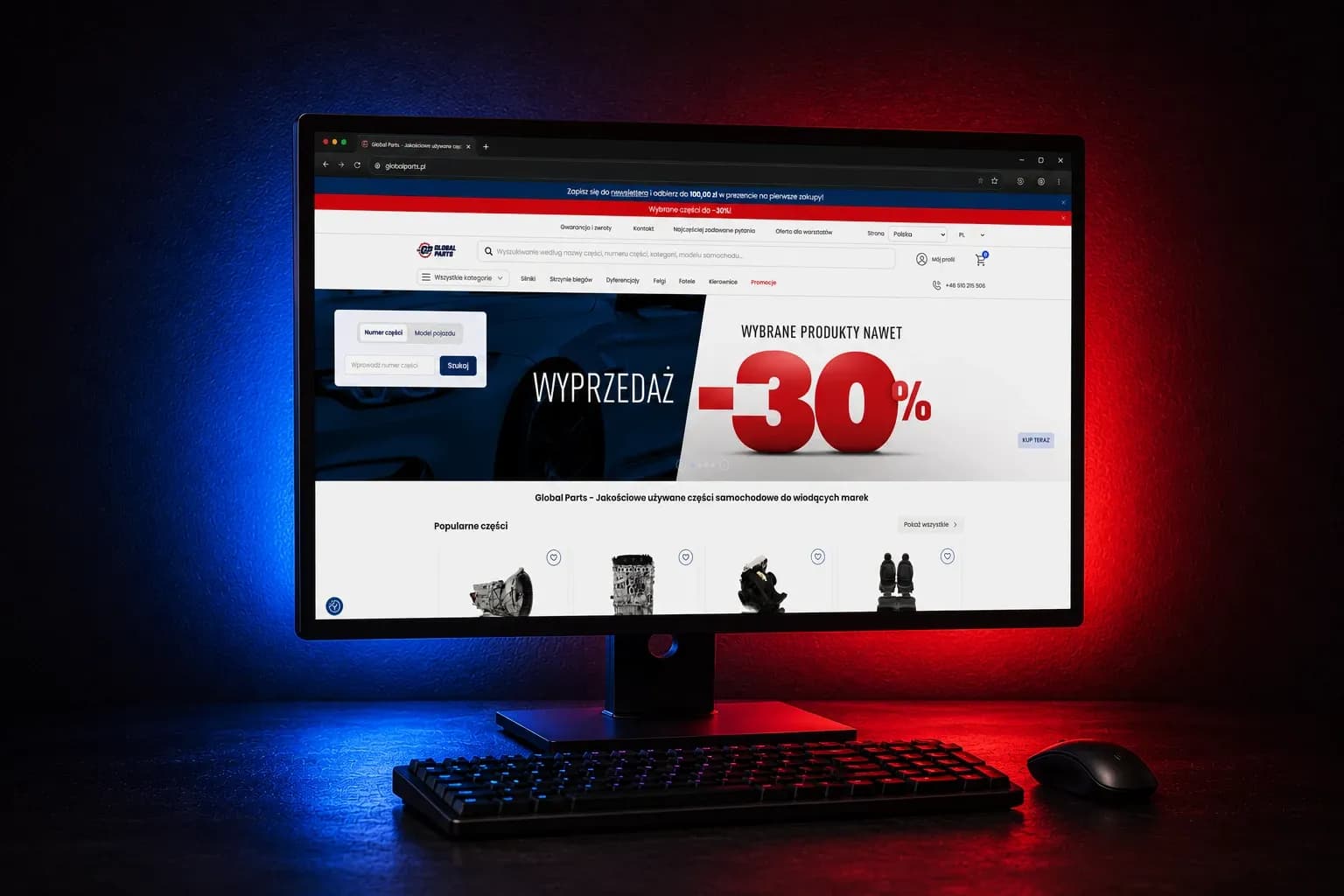
Its own store in 9 markets instead of depending on marketplaces
Client: Global Parts
Industry: Automotive / Mobility
We work with parts manufacturers and distributors and automotive brands that sell online. We build stores and catalogs where customers get to the right part - by make, model and engine version, by OE number or by replacement. We make sure that expanding into new markets means configuring the existing platform, not building another store from scratch.
Our clients in automotive


E-commerce in the automotive industry needs more than a standard product catalog. What's crucial is matching parts to a specific vehicle quickly and reliably. We design catalogs and stores where users can find a product based on make, model, vehicle version, OE number or other available data. With a large number of SKUs, consistent product data and a single source of information for the store, marketplaces and other sales channels are especially important.
Customers don't buy an oil filter — they buy a filter for a specific engine in a specific model year. So an automotive store depends on fitment data: the make–model–version tree, OE numbers and cross-reference tables. This data has to be maintained systematically, because every fitment error means a return and lost trust. With tens of thousands of SKUs, managing descriptions by hand stops working — order is kept by a single source of product data that feeds the store, marketplaces and partner catalogs.
Selling abroad adds its own challenges: languages, currencies, delivery costs and times, different sales documents. A multi-market architecture from the start — instead of cloning the store for each country — decides whether expansion is a matter of configuration or a separate project. That's how we built an e-commerce platform for a parts distributor selling in international markets.
For automotive manufacturers and brands, a well-organized product catalog, consistent brand presentation and materials for partners and distributors may matter more. We build websites that combine a product catalog with documentation, photos, downloadable materials and content for different markets.
Client: Global Parts
Industry: Automotive / Mobility
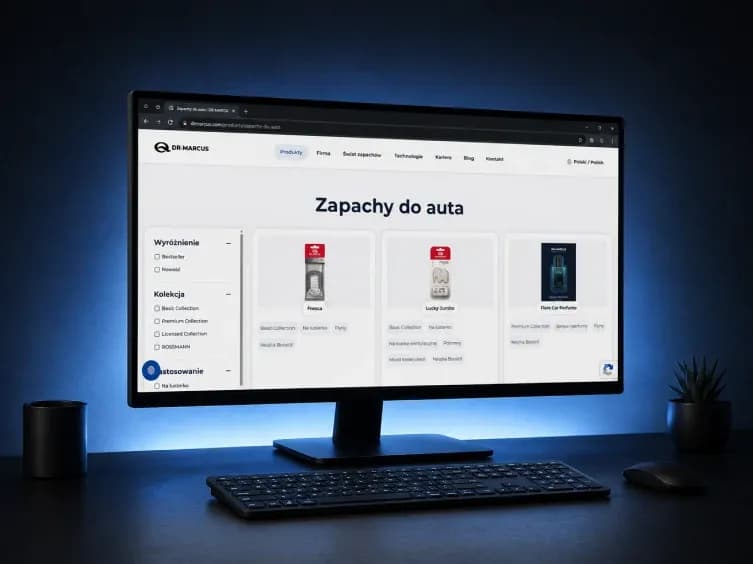
Client: Dr Marcus
Industry: Automotive / Mobility
„A shared vision worked out at the start, constant contact during design and a rollout without any major surprises. Deadlines were met.”
Tomasz Szpin — Director, GlobalParts-UK Limited
Review from ClutchThe basics
The automotive industry is split into several worlds with completely different needs: vehicle sales, servicing, spare parts, rental and fleet. What they have in common is that each works with a catalog full of variants and dependencies - a part fits specific model years, engine versions and trim levels.
That's why the biggest return usually isn't in the website, but in searching for parts by vehicle parameters and in handling service inquiries. A customer who finds the right part on their own stops taking up an advisor's time; a customer who gets it wrong generates a return and a complaint. The second area is handling inquiries - service, warranty and distribution. That's usually where the phone and the inbox eat up the most time, and where it's easiest to win it back.
How we work
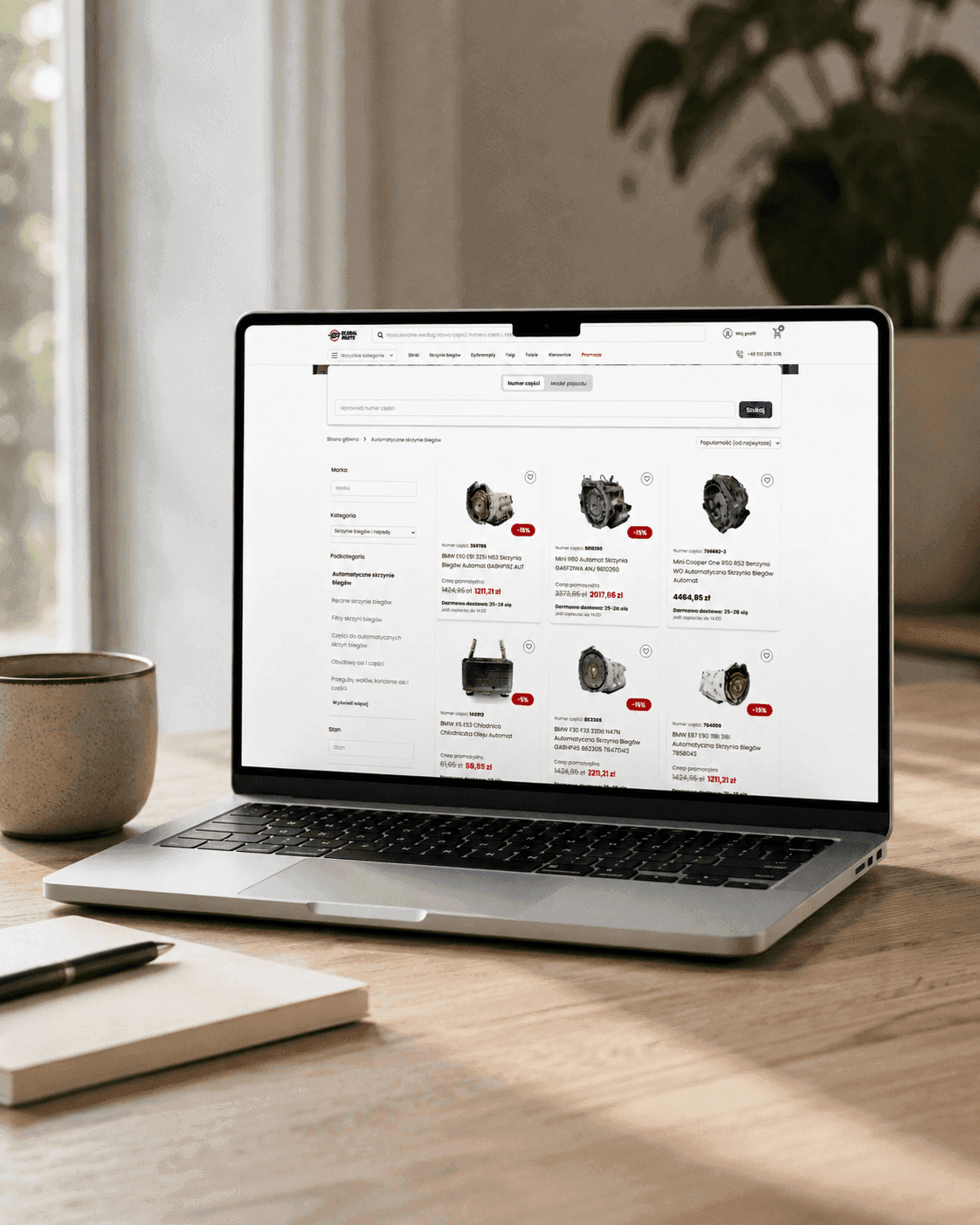
We start by getting to know the real process and the systems the company uses. We look at where data is retyped by hand, where product and vehicle information comes from and which elements can be automated. Then we sort out the catalog data: where part numbers and vehicle fitments come from, how they're updated and which system is the source of truth. Without this, the parts search will show an incomplete range, and that's worse than having no search at all.
On your side are the catalog data and access to suppliers' systems, the service rules and someone who knows how customer service really runs. On our side are integrations, the search engine and deployment.
The timeline depends above all on the quality of the fitment data. Data from a manufacturer in a standard format goes quickly. A catalog assembled from several sources needs merging, and that's usually the longest stage of the project - which is why we quote it separately.
Decisions
How customers search. By part number, by make and model, by VIN — each route needs different data. Searching by VIN is usually the most effective, but it requires access to fitment data that not every supplier provides.
What you show when you're not sure. It's better to label a part "check fitment" than to show it as compatible and then accept a return. This decision translates directly into the cost of returns.
Whether servicing can be booked online. Booking without knowing the repair time throws the schedule off. A middle ground — a request with a proposed slot to be confirmed — usually works better than full automation.
What not to do. Don't launch a parts search on incomplete fitment data. Don't keep the service schedule in two places. And don't hide availability if you know it — customers will call to ask anyway.
Scope
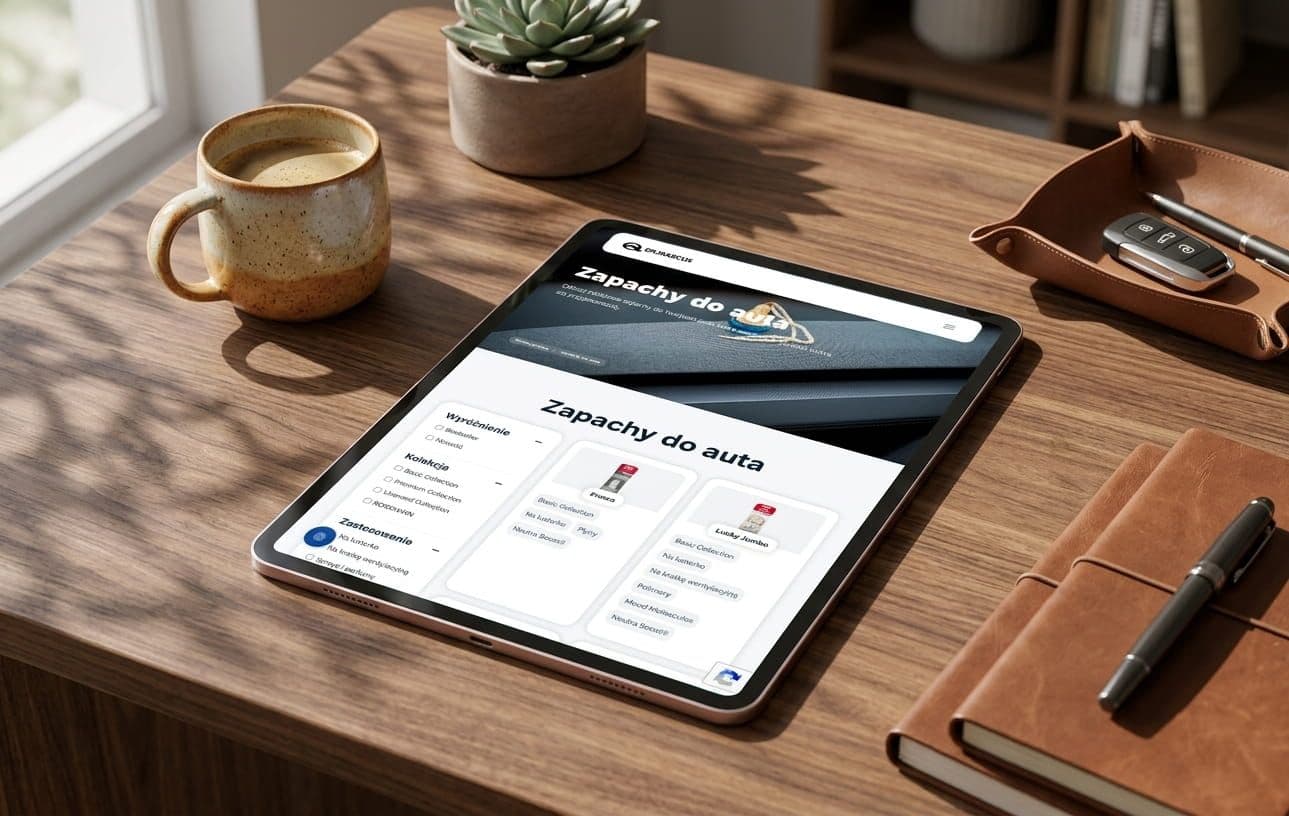
For Global Parts, we built a solution that handles sales in nine markets. Dr Marcus, on the other hand, uses an extensive product catalog that supports the brand's international presence. In both cases, the key was a solution that allows the offer and new language versions to grow without needlessly duplicating data or entire websites.
What we build
We build, among other things:
We tailor the project scope to the client's existing processes, data and systems.
Catalog scale
In automotive, a catalog can include tens or hundreds of thousands of products and even more links between parts and vehicles. That's why we design solutions that make it easier to import and update data, detect gaps and manage large numbers of variants. A well-organized catalog structure also supports SEO - especially for searches about specific parts, models, manufacturers and part numbers.
FAQ

We design and develop digital solutions for financial services, insurance and lending companies and FinTech startups. We build online application forms, calculators, customer portals and custom systems, combining good UX with data security and a reliable architecture. We simplify processes that should feel simple to the user — even when complex rules, integrations and business requirements are running underneath.

For developers, real estate agencies, rental operators and PropTech companies, we build systems that bring order to sales, rentals and property data. We build custom CRMs, listing portals, booking systems, customer portals and analytics tools, among other things - integrated with the solutions your team already uses.

In construction and ConTech, we work with contractors, developers and design firms. We build construction project databases, job management systems and websites that bring order to B2B communication. Digitization arrives later here than elsewhere, so the starting point is often replacing paper and spreadsheets with one coherent system with a change history.

We build e-learning platforms and LMS systems for EdTech startups, universities, training companies and language schools. Here, success is measured by completed courses, not by the length of the feature list — so we start with the learner's journey: the first visit, visible progress and getting back to learning that was interrupted two weeks ago. Payments, group licenses and reports all serve that one goal.

We design websites and custom software for law firms, in-house legal departments and LegalTech companies. We build calculators, qualifying forms, document workflow systems and solutions that make case handling more efficient, among other things. We automate repetitive processes and leave legal judgment to the lawyer.

For game studios, streaming platforms and brands that build communities, we create social apps, loyalty systems and content platforms. We design them for scale, traffic spikes and user engagement - from the first version of the product to its further development.