
Electrical Engineering / SmartTech
We work with distributors and manufacturers of electrical components and SmartTech devices. We build technical catalogs, B2B e-commerce platforms and apps that work with IoT devices. We design solutions ready for tens of thousands of products, extensive technical data, customer-specific price lists and ERP integrations.
Our clients in electrical engineering
A technical catalog customers can search by parameters
In the electrical industry, customers often don't search for a product by name but by specific parameters. That's why a well-designed product data model is the foundation of a good online store or B2B platform.
Parametric search in technical e-commerce
Electricians, installers and automation engineers filter products by voltage, current rating, IP rating, dimensions or standards, among other things. For that kind of search to be fast and precise, product data needs a clear structure: the right attributes, units and relationships between products, such as replacements, accessories and kits.
B2B sales add customer-specific price lists, credit limits, quick orders for many products, purchase history and reordering. So the platform should reflect the way business customers actually buy.Where these projects come from
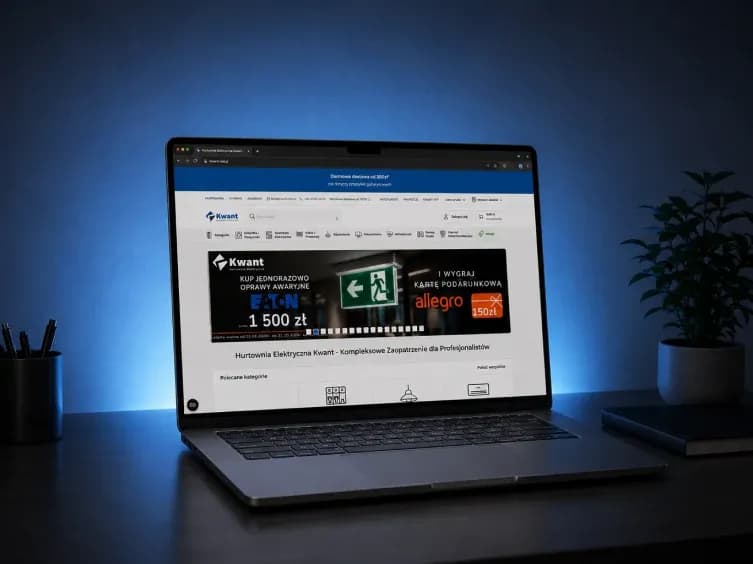
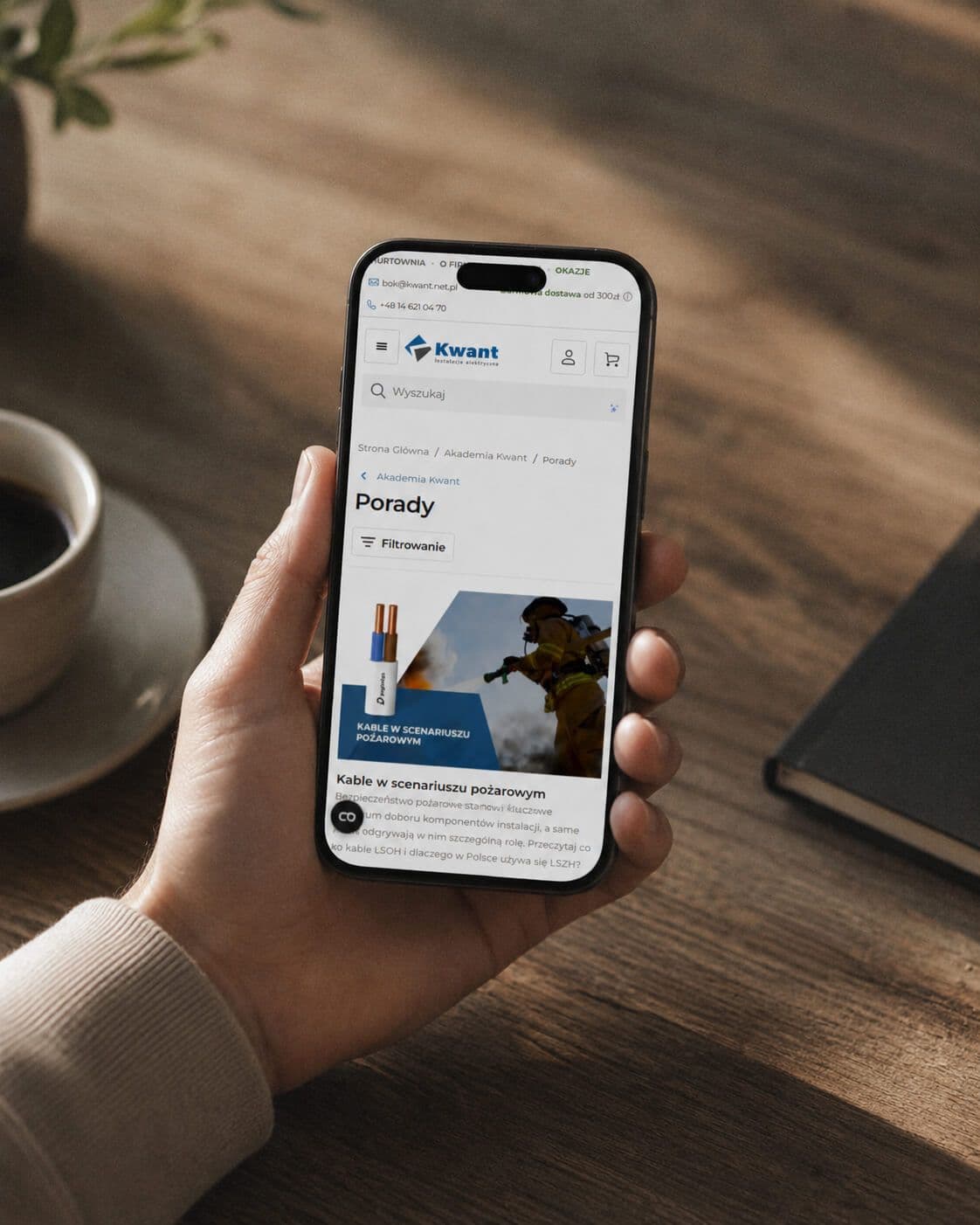
A typical starting point is a distributor with its catalog in the ERP and sales over the phone, who wants to move regular customers online without losing their individual terms. A project like this starts with integration: stock levels and prices flow from the ERP, and orders go back to it automatically. Our project for the Kwant electrical wholesale chain shows what this looks like in practice — a B2B/B2C platform built around a fast front end and search visibility.
Case studies in electrical engineering
„Boring Owl delivered the project as planned and on schedule. The website is fast and performs well in search results, and working with the team was smooth and professional.”
Michał Rugiełło — E-Commerce Director, Kwant Hurtownie Elektryczne sp. z o.o.
Review from ClutchThe basics
Where electronics ends and software begins
SmartTech covers connected devices and everything that runs them: data collection, control, updates and user apps. What sets it apart is that the system includes a layer that can't easily be fixed — the devices are already with customers. That leads to the main design principle: whatever is built on the device side must be updatable remotely. Without that, every fix means a service visit or replacing hardware, and that costs far more than updating an app.
In SmartTech projects, safely updating devices that are already in customers' hands is also essential. A well-planned update mechanism lets you develop the product without physically servicing every device.
How we work
How we approach projects involving devices
We start by analyzing how the device works, how data flows and which processes the system needs to support. We decide what should happen locally, what on the server side and how the app should behave when the connection drops. Then we design the architecture, the server layer and the user app. If the project requires it, we also cover communication with the devices and their remote update mechanism.
On your side are the devices, the protocol documentation and decisions about the scope of control. On our side are the architecture, the server layer, the app and updates.
The timeline depends on the number of device types and whether the communication protocol is open. A manufacturer's closed protocol can be a project boundary that simply can't be moved.
Decisions
Decisions that are hard to undo once devices have shipped
How device updates work. This is the first thing to design, not the last. It also has to cover the case where an update is interrupted halfway — the device should return to a working state, not stop turning on.
What works without a server. The device's core function should work locally. Making it depend on the cloud passes every service outage straight on to the customer.
How much data you send. Every reading taken once a second means transmission and storage costs multiplied by the number of devices. It's worth running the numbers for the target scale, not for the prototype.
What not to do. Don't ship devices without an update mechanism. Don't make the core function depend on a connection. And don't test only in a simulator — real-world network conditions are a whole separate category of problems.
Scope
Technical e-commerce for tens of thousands of products
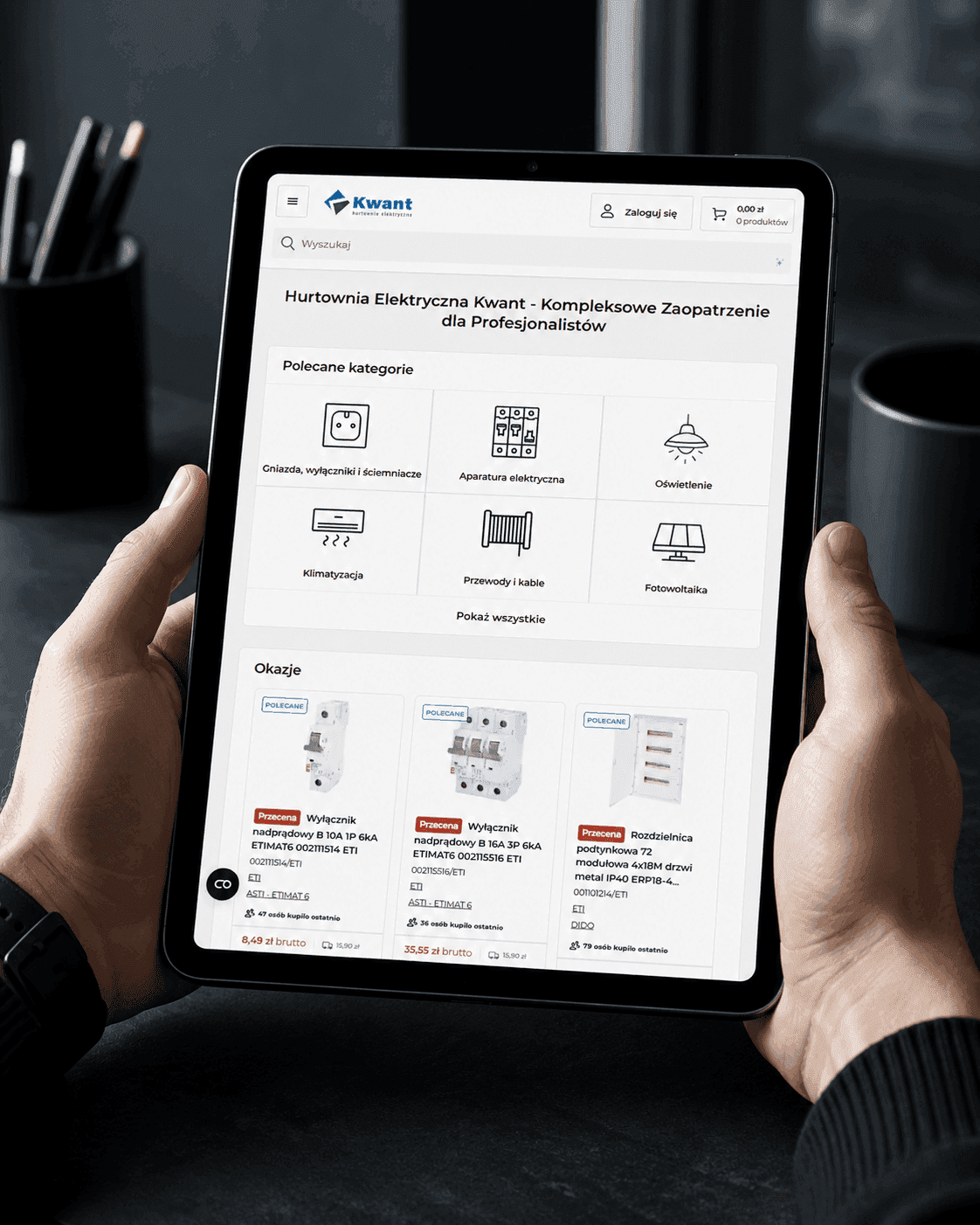
The online store of the Kwant electrical wholesale chain handles tens of thousands of products. At that scale, fast search, filtering by technical parameters, access to stock levels and convenient order handling are key.
When designing e-commerce for the electrical industry, we also plan integrations with the systems used in sales, logistics and product management.What we build
B2B platforms, customer-specific pricing and ERP integrations
Technical B2B sales work differently from classic consumer e-commerce. Customers may have their own price lists, trade terms, credit limits or the option to place large orders. We build B2B platforms integrated with the ERP and other company systems, so price, product and availability data can sync automatically and orders go straight to fulfillment.
Technical data
Product parameters as the foundation of search
In the electrical industry, customers often search by cross-section, voltage, current rating, standard or dimensions. That's why the structure of technical data directly affects the quality of search and filtering.
We organize attributes, units and data ranges as early as the product import stage, so customers can quickly find the right variant and the risk of a wrong order is reduced.FAQ
Questions we hear from the electrical engineering industry
- In most cases yes. The scope of integration depends on the ERP system and the available API or other data exchange method. We can synchronise products, prices, stock levels, customers and orders, among other things.
- The key is a solid product data structure and efficient search and filtering. We design the catalogue so that users can quickly narrow results by parameters specific to each product category.
- Yes. The system can handle individual price lists, discounts, trade terms, credit limits and order history. We model the specific rules according to the company's sales process.
- Yes, if the device provides a sufficiently documented communication method — an API or an open protocol, for example. We verify the technical integration possibilities before the project begins.
- The best approach is a secure OTA remote update mechanism. It should allow controlled rollout of new versions, update verification and rollback to a previous version if problems occur.
- With clean product data and clear pricing rules — a few months; the complete Kwant store frontend was built in under six. The timeline depends mainly on the state of the data: if it's scattered across an ERP, spreadsheets and manufacturer catalogues, consolidating it — not writing code — sets the schedule. We usually recommend starting with a narrower catalogue scope and one customer segment so the store goes live while you're still tidying up the rest.
- Ideally from one clean source. If manufacturers supply data in industry standards, we base the catalogue structure on them — that saves work with every new supplier. If data arrives in spreadsheets and PDFs, the first project phase is organising it, and it's worth scoping that separately because it often turns out to be larger than the store implementation itself.

Let's build digital products for your company together
Other industries
SEE ALL5 CASE STUDIES
Finance / FinTech
We design and develop digital solutions for financial services, insurance and lending companies and FinTech startups. We build online application forms, calculators, customer portals and custom systems, combining good UX with data security and a reliable architecture. We simplify processes that should feel simple to the user — even when complex rules, integrations and business requirements are running underneath.

8 CASE STUDIES
Real Estate / PropTech
For developers, real estate agencies, rental operators and PropTech companies, we build systems that bring order to sales, rentals and property data. We build custom CRMs, listing portals, booking systems, customer portals and analytics tools, among other things - integrated with the solutions your team already uses.

5 CASE STUDIES
Construction / ConTech
In construction and ConTech, we work with contractors, developers and design firms. We build construction project databases, job management systems and websites that bring order to B2B communication. Digitization arrives later here than elsewhere, so the starting point is often replacing paper and spreadsheets with one coherent system with a change history.

3 CASE STUDIES
Education / EdTech
We build e-learning platforms and LMS systems for EdTech startups, universities, training companies and language schools. Here, success is measured by completed courses, not by the length of the feature list — so we start with the learner's journey: the first visit, visible progress and getting back to learning that was interrupted two weeks ago. Payments, group licenses and reports all serve that one goal.

3 CASE STUDIES
Law / LegalTech
We design websites and custom software for law firms, in-house legal departments and LegalTech companies. We build calculators, qualifying forms, document workflow systems and solutions that make case handling more efficient, among other things. We automate repetitive processes and leave legal judgment to the lawyer.

2 CASE STUDIES
Automotive / Mobility
We work with parts manufacturers and distributors and automotive brands that sell online. We build stores and catalogs where customers get to the right part - by make, model and engine version, by OE number or by replacement. We make sure that expanding into new markets means configuring the existing platform, not building another store from scratch.