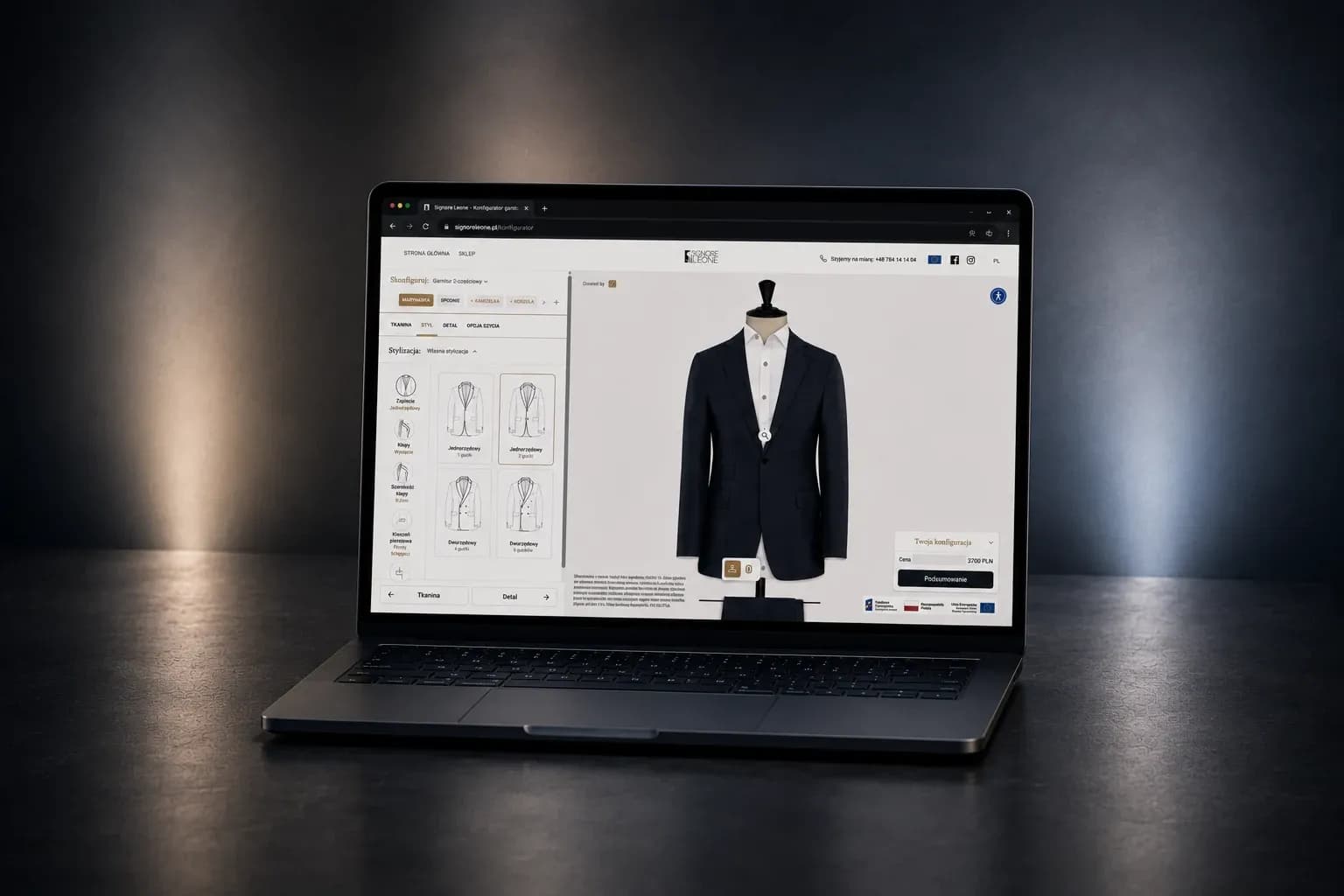
An online suit configurator – customers arrive at the showroom knowing what they want
Client: Signor Leone
Industry: Fashion / FashionTech
We build online stores, catalogs and configurators for clothing brands, manufacturers and retailers selling across several channels at once — from catalogs with hundreds of variants to a made-to-measure suit configurator. A fashion product is a matrix of variants: style, color and size, each with its own stock level and photo. Sales depend on presentation and on being sure the chosen size is really in stock, and returns are part of the model, not the exception.
Our clients in fashion
We build online stores, catalogs and configurators tailored to fashion brands — from classic e-commerce to more complex sales models.
A fashion product is a matrix of variants: style × color × size, each with its own stock level and often its own photo. A store that treats each variant as a separate product clutters the catalog; a store that doesn't track stock by size sells things it doesn't have. Then there's the photo shoot as a process: new collections arrive in batches, and the catalog has to accept products before all the photos are ready. We design this kind of data model as part of building the online store, before the first screen is created.
In fashion, returns are part of the business model, not the exception — customers order two sizes and send one back. A convenient returns process lowers service costs and doesn't discourage future purchases; good size charts and photos on models reduce the volume of returns in the first place.
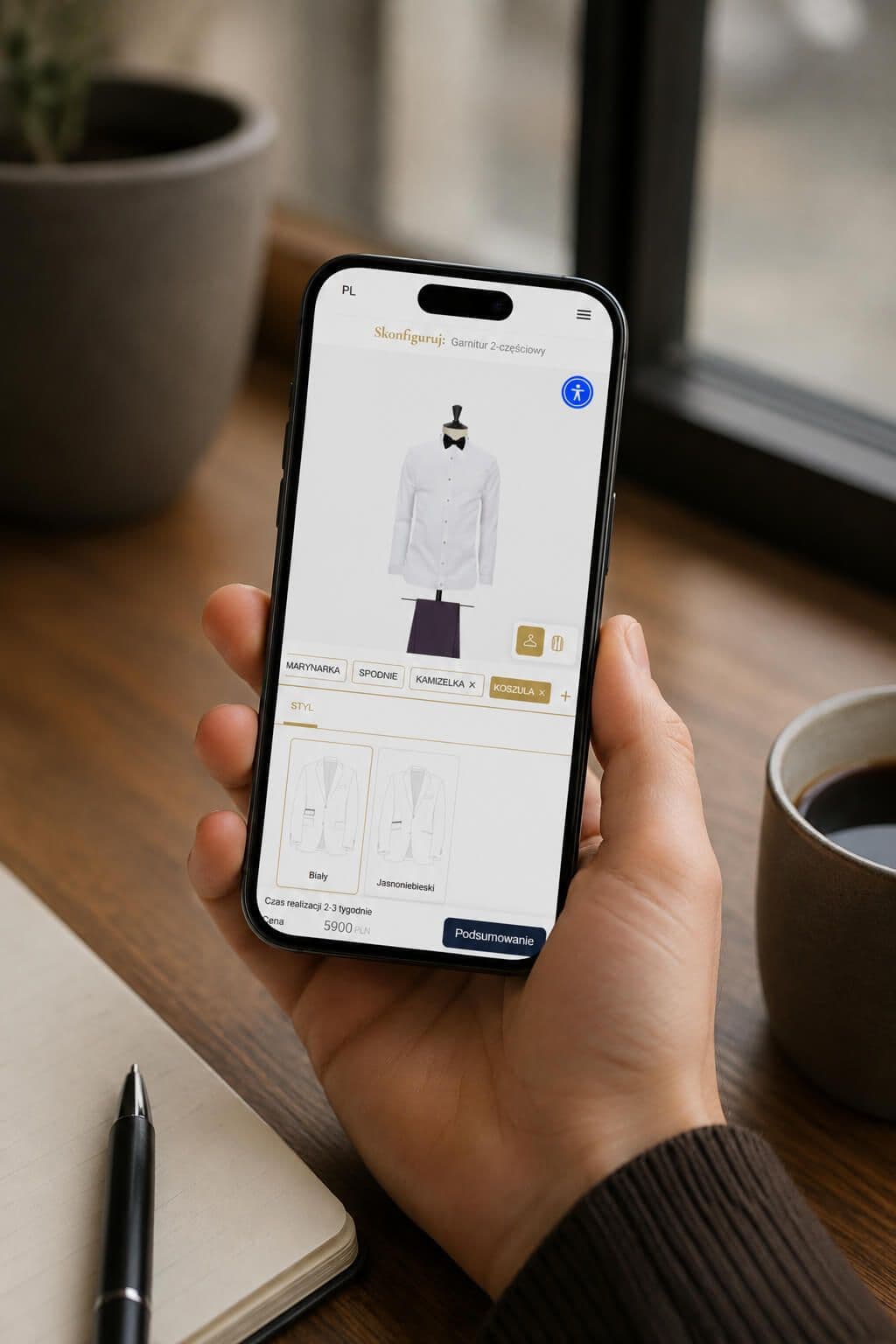
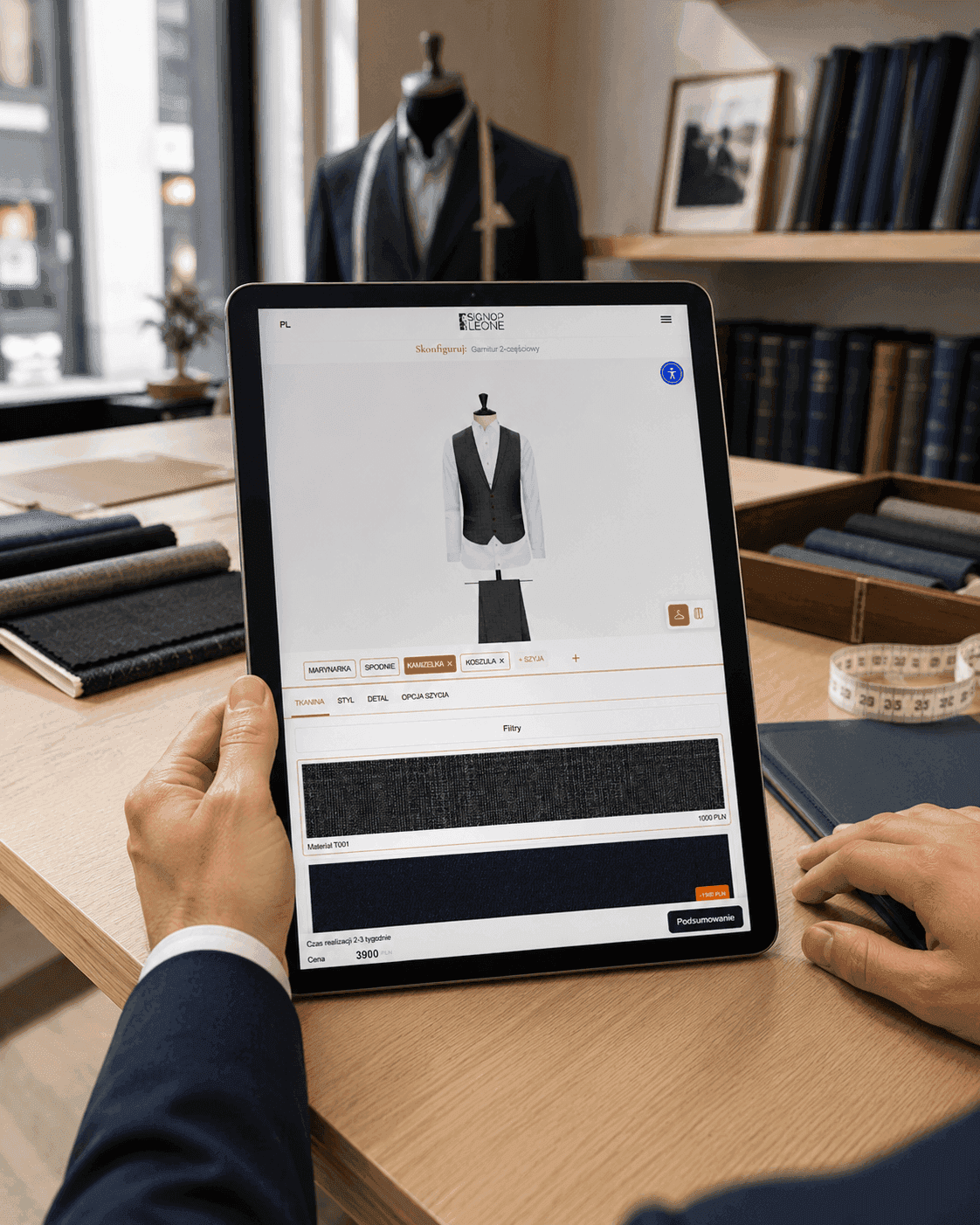
For made-to-measure clothing or personalized products, a standard store may not be enough. We build product configurators that let customers choose the fabric, cut, color or extra details, see the price and a preview of the product, and then send the complete specification to production.
We built a solution like this for Signor Leone, among others, creating a configurator for made-to-measure suits.Client: Signor Leone
Industry: Fashion / FashionTech
„They're transparent and work efficiently. They always help find the best possible solution within the budget.”
Anonymous — Executive, Castellani
Review from ClutchThe basics
Fashion is ruled by three things that other categories don't face to the same degree: variants (size × color × style), seasonality and returns. Each of them hits a different part of the system, and together they decide whether the store can be run without an army of people.
Variants multiply the work on descriptions, photos and stock levels. Seasonality means the entire range is replaced several times a year — so how quickly a new collection can go live matters more than anything else. Returns can reach tens of percent, which makes handling returns as important a process as selling.
Well-designed product data and integrations make it possible to launch collections faster, cut manual work and keep information consistent across all sales channels.
How we work
We start by getting to know the current sales process: how products, variants, stock levels, photos and returns are managed. Then we identify what's worth simplifying or automating and plan the integrations needed. If the brand sells across several channels, we also decide where product and availability data should come from.
On your side are the product data and photos, the returns policy and decisions about size charts. On our side are implementation, integrations and automating the returns process.
The timeline depends on the number of variants and how consistently sizes are described. A collection with a uniform size grid goes live quickly; a range from several suppliers with different labeling needs standardizing, and that's usually the longest stage.
Decisions
The number of product variants. The more combinations of sizes, colors, styles or lengths, the more a well-designed catalog structure and data management approach matter.
How returns work. A label in the parcel, an online form, an in-store drop-off — each option means a different cost and different customer expectations. With a high return rate, automating this process pays off faster than most other changes.
Whether you sell across several channels. If you do, a single source of product data stops being a convenience and becomes a requirement — otherwise the same product has a different description everywhere.
What not to do. Don't enter collections by hand in each channel separately. Don't hide the size chart — it's one of the main reasons for returns. And don't launch the store without testing the full returns path, all the way to the item going back into stock.
Scope
FashionTech solutions can cover much more than a standard online store. We build configurators, product catalogs, custom interfaces and systems that support selling across many channels and markets. We match solutions to the brand's business model — without adding features the team and customers won't need.
We built the Signor Leone suit configurator, which moves choosing the fabric, cut and details online — customers arrive at the showroom with their minds already made up.What we build
We design stores that handle sizes, colors and other variants without needlessly duplicating products. We can implement size charts, rich galleries, configurators, warehouse integrations and solutions that support omnichannel sales. We also plan for seasonal collection launches, sales and peak traffic periods.
Brand
In fashion, visual identity sells — the store has to carry the brand through typography, photo framing and the details of interactions. We design interfaces that use the brand's typography, photography and signature visual elements instead of settling for a ready-made template.
Performance can't suffer, though. A beautiful store that takes six seconds to load loses to a less attractive one that's twice as fast — and in fashion most traffic is mobile, so you see the difference in the cart straight away. Design and code are done by one team, so what appears in the mockup is backed by something that can actually be maintained.FAQ

We design and develop digital solutions for financial services, insurance and lending companies and FinTech startups. We build online application forms, calculators, customer portals and custom systems, combining good UX with data security and a reliable architecture. We simplify processes that should feel simple to the user — even when complex rules, integrations and business requirements are running underneath.

For developers, real estate agencies, rental operators and PropTech companies, we build systems that bring order to sales, rentals and property data. We build custom CRMs, listing portals, booking systems, customer portals and analytics tools, among other things - integrated with the solutions your team already uses.

In construction and ConTech, we work with contractors, developers and design firms. We build construction project databases, job management systems and websites that bring order to B2B communication. Digitization arrives later here than elsewhere, so the starting point is often replacing paper and spreadsheets with one coherent system with a change history.

We build e-learning platforms and LMS systems for EdTech startups, universities, training companies and language schools. Here, success is measured by completed courses, not by the length of the feature list — so we start with the learner's journey: the first visit, visible progress and getting back to learning that was interrupted two weeks ago. Payments, group licenses and reports all serve that one goal.

We design websites and custom software for law firms, in-house legal departments and LegalTech companies. We build calculators, qualifying forms, document workflow systems and solutions that make case handling more efficient, among other things. We automate repetitive processes and leave legal judgment to the lawyer.

We work with parts manufacturers and distributors and automotive brands that sell online. We build stores and catalogs where customers get to the right part - by make, model and engine version, by OE number or by replacement. We make sure that expanding into new markets means configuring the existing platform, not building another store from scratch.