




























E-commerce
We design and build online stores and e-commerce platforms tailored to your sales model and business processes. We work with off-the-shelf solutions as well as headless architecture and custom sales systems. We build e-commerce for B2C and B2B sales, large product catalogs, multiple markets and marketplaces. We integrate stores with ERP, WMS, CRM, PIM, payments and logistics, and design product configurators and custom purchase flows. We also take care of performance, technical SEO and preparing the platform for seasonal traffic peaks.
Companies that trusted us
The basics
When an off-the-shelf platform, and when a custom online store?
Launching an online store doesn't end with getting the cart and payments working. Effective e-commerce has to be connected to the whole sales process - stock levels, prices, invoices, shipping, returns and order handling. If these elements work separately, the number of manual tasks and errors grows along with sales. With a relatively simple product catalog and sales in a single market, an off-the-shelf e-commerce platform is often the best solution. It lets you launch faster, keep the initial cost down and simplify running the store later.A custom e-commerce build starts to have the edge when you have a large or complex product catalog, many variants and pricing rules, B2B sales, several markets, integration with an ERP or warehouse system, or a purchase process that an off-the-shelf platform can't handle properly.Selling through marketplaces is a separate decision. They give you access to existing traffic, but come with commissions and limit your direct relationship with customers. Your own store requires building traffic sources, but gives you more control over your brand, data and sales process. For many companies, the best solution is a combination of both channels.
See the e-commerce projects we delivered for clients

A home-cooked meals marketplace with Wolt delivery – selling your own food legally
Client: HomeChefs
Industry: Food Industry / FoodTech
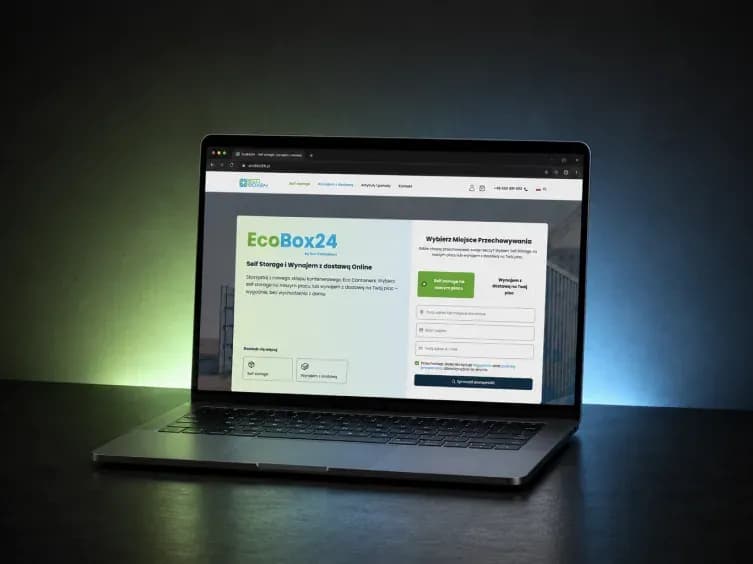
Renting storage in minutes instead of days – automated contracts and payments
Client: Balticon S.A.
Industry: Logistics / LogTech
„The project was carried through from start to finish. Our site is fast and our customers are very happy with it. They are very professional and easy to communicate with. They always help find the best solution within the budget.”
Kadra zarządzająca — Castellani
Review from Clutch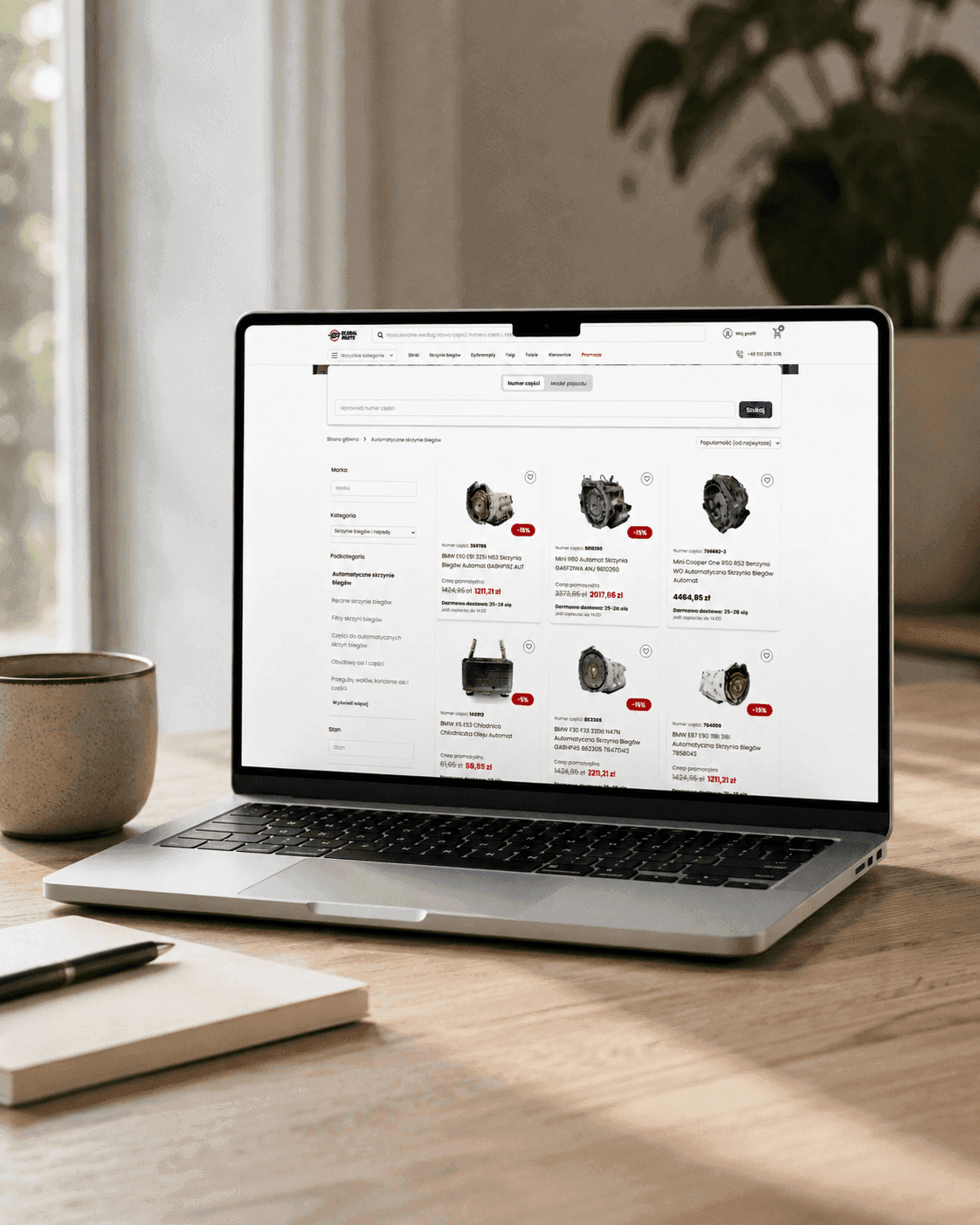
How we work
From catalog to first order - stages and responsibilities
We start with the products, the data and the sales process, not by choosing a template. First, we analyze the catalog structure: categories, variants, attributes, prices, availability and how product data is managed. These decisions later shape search, filtering, integrations and the store's ability to grow. Based on that, we design the UX and purchase path, choose the technology and plan the integrations. On our side there can be UX/UI design, development, payment and shipping integration, connections with ERP or WMS systems, data migration, testing and launching the store.
On the client's side, we mainly need well-organized product data, photos and descriptions, access to the systems being integrated, and agreed rules for payments, shipping and returns. With large catalogs, preparing product data is often one of the most time-consuming stages, so it's worth starting it in parallel with the design.
The timeline depends mainly on the functional scope, the number of integrations, the size of the catalog and the quality of the data. A store built on an off-the-shelf platform with a well-organized catalog can be launched much faster than multi-market e-commerce with an ERP, order history migration and custom B2B processes.
Decisions
The most important decisions in an e-commerce implementation
An off-the-shelf platform or a custom solution? It's worth comparing not just the cost of launching the store, but the total cost of running it over several years. With subscription platforms, licenses, commissions and the cost of add-on apps all matter. With a custom solution, the upfront cost and later development costs are higher, but you gain more control over features and architecture. That's why we base our platform recommendation on your business model and growth plans, not on a single technology we use in every project.
One source of product data. If product information is edited in the store, the ERP, spreadsheets and other systems at the same time, discrepancies will appear sooner or later. That's why, at the very start of the project, we decide which system is the main source of product, price and stock data. It could be the ERP, a PIM or another central system.
Integration scope. Not every integration has to be built for the first version of the store, but the systems critical to sales should be planned from the start. We decide which connections to the ERP, WMS, CRM, accounting system, payments, couriers or marketplaces are needed before launch and which can be added in later stages. This way, the project scope matches the company's real needs.
Migration and SEO. When migrating an existing store, you need to take care not only of moving products and customers, but also of your existing visibility in Google. We analyze the URL structure, prepare a mapping of old and new pages and set up 301 redirects. We also check indexing and traffic before and after the migration. This reduces the risk of losing visibility.
Scope
Stores built around the sales process, not a template
We build stores around the sales process: for Kwant, a nationwide chain of electrical wholesalers, that meant one interface bringing together tens of thousands of products with filtering by technical parameters; for Global Parts — its own store in 9 markets instead of depending on marketplaces and their commissions; for Baza Cosmetics — a premium cosmetics marketplace on Shopify Plus, also in 9 European markets.
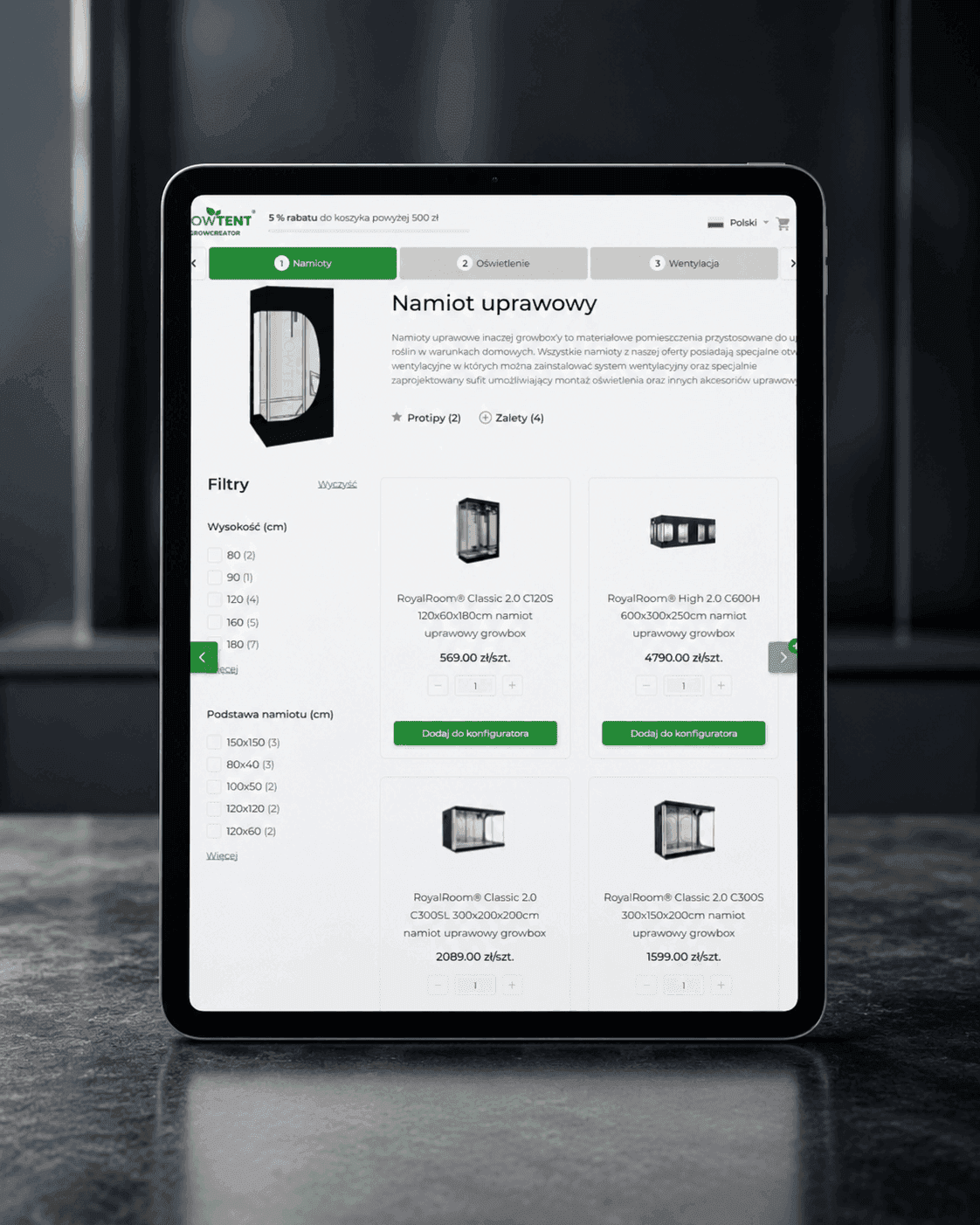
GrowTent got a configurator that picks growing equipment and fills the cart on its own — taking over the advisory work a salesperson used to do over the phone. HomeChefs — a marketplace for home-cooked meals with Wolt delivery and fully compliant sales.
Technologies we work with
- Store and content
We build the store on Shopify or WooCommerce — depending on scale and processes; when the store is part of a larger website, Strapi manages the catalog and content.
- Front end and payments
We build the storefront in Next.js, payments are handled by Stripe and order data is stored in PostgreSQL.
Integrations
ERP, warehouse, payments and logistics in one flow
A store without integrations is only half the job. We connect the ERP and warehouse systems so that stock levels and prices come from a single source instead of manually updated spreadsheets; payments are handled by Stripe or a local provider — including refunds and deferred payments; and we connect shipping with courier brokers. A flow built this way powered contract and payment automation at Balticon S.A., which cut rental time from days to minutes.
Ahead of peak sales periods, we also run performance tests to check where bottlenecks might appear. It's better to find performance problems during testing than on Black Friday.

Platforms
Shopify, WooCommerce or a custom store — we choose, we don't push
We don't have one favorite platform. We chose Shopify Plus for Baza Cosmetics because a multi-market premium cosmetics marketplace needed a mature sales back end faster than a custom one could be built. We recommend WooCommerce where the store is an add-on to content and budget is the priority. We build custom stores on Next.js with Strapi when the sales process is a competitive advantage — like the Signor Leone suit configurator, which sends customers to the showroom with their minds already made up.
We can justify every recommendation by total cost: licenses, commissions, development and maintenance over the years, not just the price of the build.
Real Estate / PropTech
For developers, real estate agencies, rental operators and PropTech companies, we build systems that bring order to sales, rentals and property data.
Real Estate / PropTech ↗
PRODUCTS
Tell us what you want to build — we'll take care of the rest

We design and build mobile apps for companies and startups — from concept and UX/UI to development, backend, app store release and ongoing development. We work natively in Swift and Kotlin, and cross-platform in React Native and Flutter. We choose the technology based on the product, its features, the budget and plans for growth.

We build booking systems that take a booking, collect payment and handle cancellations without human involvement — for accommodation providers, equipment and space rental, and appointment-based services. We connect bookings with payments, availability calendars, a channel manager and service automation, so customers can check availability, book and pay without contacting staff.
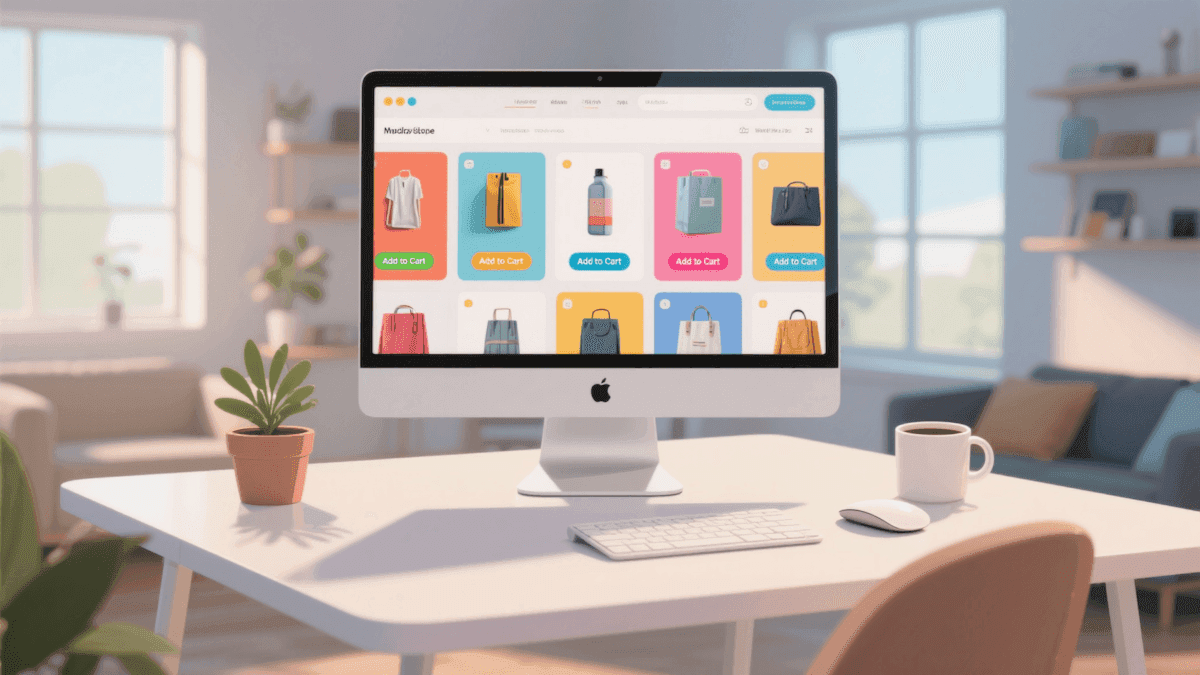
We design and build B2B and B2C marketplace platforms — from an MVP to full-scale multi-vendor systems. We build the buyer and seller sides, commission models, payments, integrations and operator tools. A marketplace is two products at once: one for the buyer and another for the seller — we design both, together with the settlement model.
We design and build websites that help companies present their offer, win customers and grow their visibility in Google. We combine UX/UI, a fast front end and an easy-to-use CMS, choosing the technology based on how the site will be developed later on. We build both new company websites and redesigns of existing ones. We work with Next.js, Strapi and Webflow, among others.
FAQ
Questions we hear before an implementation
The cost is most strongly influenced by three things: the number of integrations with existing systems, how non-standard the pricing and order process is, and the state of the product data. A store on a ready-made platform with a clean catalog goes live quickly; the same store with product descriptions from several suppliers costs significantly more, because data consolidation becomes the longest phase. You also need to factor in ongoing costs — the platform subscription, payment provider fees and maintenance.
- It depends mainly on the size and structure of the catalog, the number of markets, the sales model and the required integrations. For a relatively simple catalog and a standard checkout process, a ready-made e-commerce platform is usually faster and more cost-effective. With a large number of variants, B2B sales, multiple markets, a non-standard checkout or advanced integrations, a custom-built or headless solution gives you more flexibility. We prepare a specific recommendation after analysing the product catalog and the systems the store needs to connect with.
- SEO is a separate element of a store migration. Before the switch we analyse the existing URLs and site visibility, prepare URL mapping and 301 redirects, and after launch we monitor indexing and organic traffic. A well-prepared migration significantly reduces the risk of losing visibility, though large structural changes can cause temporary position fluctuations.
- Yes. We integrate e-commerce platforms with ERP, WMS, accounting systems, CRM, PIM, payment providers and logistics services. We agree on the integration scope at the start of the project. Systems critical to order processing are implemented before launch; less essential features can be rolled out in stages.
- The timeline depends on the project scope, platform, catalog size, quality of product data and number of integrations. A store on a ready-made platform with an organised catalog can be launched much faster than a custom e-commerce system with ERP, multi-market sales and data migration from a previous platform. Once we've analysed the requirements, we prepare a project scope and timeline.
- Yes. After launch we can handle technical maintenance, fixes, optimization and further e-commerce development. The first weeks after launch also provide data on user behaviour and how orders are actually processed. We use this to develop features, automations and the store's UX.

Let's build digital products for your company together
Other services

Web Development
We design and build custom web applications - from an MVP that lets you quickly validate an idea to large platforms and systems developed over years. We build both the front end and the backend, APIs, databases, admin panels and integrations with external systems. We work with Next.js, React, Node.js, NestJS, Python, PostgreSQL and MongoDB, among others. We create solutions tailored to a specific business process: SaaS applications, internal systems, sales platforms, websites, marketplaces and CMS systems.
Learn moreUX/UI Design
We design UX/UI for web and mobile applications and B2B systems - from analyzing user needs and early wireframes to the finished interface and a design system in Figma. We don't design screens in isolation from the product. We look at user journeys, analytics data and technical constraints to create a solution that's easy to use and can be built efficiently. After the product launches, we can come back to heatmaps, session recordings, analytics and user interviews, so that the next changes are driven by data, not assumptions.
Learn moreSEO / GEO
We help increase website visibility in Google and in AI-generated answers. We combine technical SEO, content optimization and work on the site structure. We start with an audit and turn the most important recommendations into concrete changes in the code.
Learn more